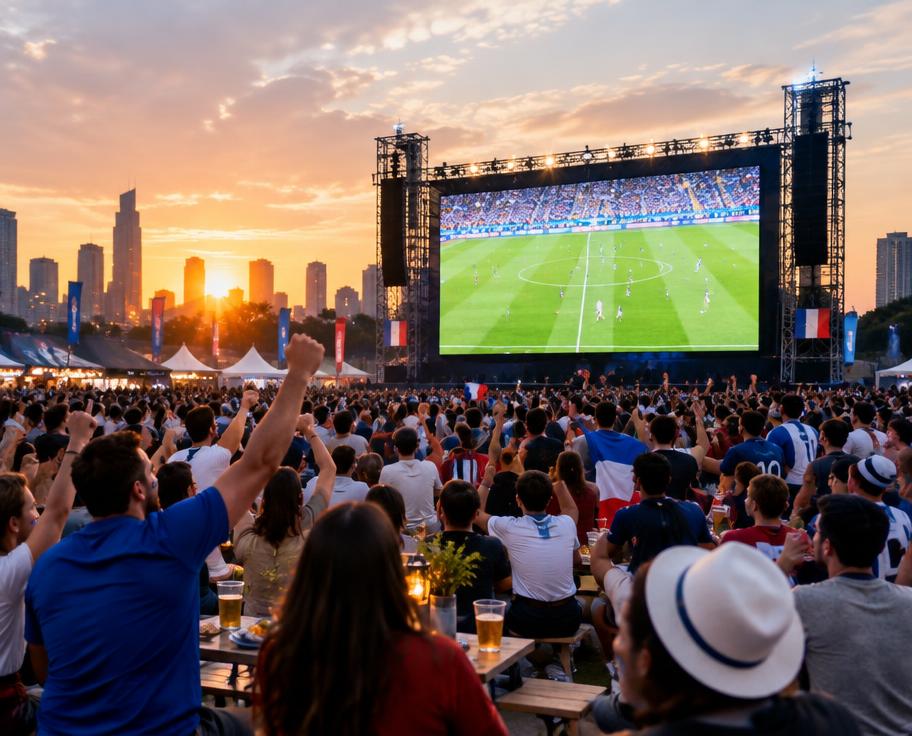
The Tournament Is Over. Now the Numbers Are In.
Spain defeated Argentina 1-0 in extra time in the final at MetLife Stadium in New Jersey on Sunday 19 July 2026, bringing the curtain down on the first FIFA World Cup to feature 48 teams, 104 matches and 16 host cities across three countries. It was, by almost every attendance and commercial metric available, the most expansive World Cup in the competition's 96-year history. Six million six hundred and sixty-five thousand eight hundred and twenty-five fans attended across the first 102 matches, at a 99.7% occupancy rate and an average of 65,351 per match. The final itself drew 80,663 fans to MetLife Stadium. And on the eve of the final, Bank of America CEO Brian Moynihan disclosed the number that the global business community had been waiting for: the tournament generated an estimated $40 billion in total global economic impact, with approximately $20 billion of that flowing through the United States economy.
That figure — confirmed by Bank of America on the basis of actual card-transaction data tracked across the 16 host cities throughout the tournament — is the most reliable single post-tournament economic figure available. It is also, notably, roughly half of the $80.1 billion in gross economic output that FIFA and the World Trade Organization had projected in their pre-tournament socioeconomic impact study. That gap between projection and reality is worth understanding rather than glossing over, because it tells an important story about how major sporting event economics actually work — and because the $20 billion US figure is still, on any honest assessment, a genuinely significant economic outcome for a five-week sporting competition.
What the Pre-Tournament Projections Said
Before a ball was kicked, the economic forecasts for the 2026 World Cup were extraordinary in scale. The FIFA-WTO joint study, produced by independent research body OpenEconomics and published in April 2025, projected a total global gross output impact of $80.07 billion — of which roughly 38%, or $30.46 billion, was projected to flow to the United States. The same study projected a global GDP impact of $40.92 billion, with 42% of that figure — approximately $17.2 billion — expected to benefit the US economy directly. Global labour income impact was projected at $20.77 billion, with 49% of that reaching American workers. FIFA projected that the tournament, combined with the 2025 FIFA Club World Cup, would create up to 185,000 full-time equivalent jobs in the United States.
The New York-New Jersey host committee, working with consultancy Tourism Economics, separately projected $3.3 billion in regional economic impact for the tri-state area alone and more than 26,000 jobs tied to the tournament. Oxford Economics, conducting independent analysis, projected that hotel room revenues across host cities would increase between 7% and 25% in June 2026, with the largest increases concentrated around match days. Airbnb projected its hosts in the 16 host cities would generate over $2.6 billion in revenue across the tournament, with the average host earning approximately $4,000 during the competition window.
What the Real-Time Data Showed
The clearest independent verification of the tournament's economic impact as it happened came from Bank of America's consumer spending analysis, which tracked actual card-based purchases across all 16 host cities throughout the competition. The first mid-tournament report, covering the June 10 to June 28 period, found that consumer spending across all host cities had increased 5.4% year on year, with non-local visitor spending up 17.4% — the clearest indicator that genuine new money was flowing into host city economies from fans travelling specifically for the competition rather than simply residents spending at local venues.
A second Bank of America update, tracking through 26 June, found that overall spending across the 16 host cities had increased 6.3% compared with the same period the previous year, again led by non-local visitors whose spending was up 16.7%. The geographic pattern was telling: the largest consumer spending gains tracked closely with match counts and the prestige of fixtures. New York, Los Angeles, Dallas and Kansas City showed the strongest individual city performance in the Bank of America data. During Team USA's group stage matches in Seattle and Los Angeles, those cities recorded overall spending increases of 5.0% and 6.8% respectively — confirming that home team presence amplified local economic activity beyond the baseline tournament effect.
Independent research firm Allianz Trade, tracking cross-border tourism spending across all three host nations, estimated total international visitor spending at approximately $8 billion — split roughly $5.4 billion in the United States, $1.4 billion in Mexico and $1.2 billion in Canada. This figure covers only international cross-border visitor spending and sits within the range implied by Bank of America's broader transaction data once broadcasting, domestic spending, sponsorship and other categories are added.
The City-by-City Picture
The economics of the 2026 World Cup were not evenly distributed — a predictable outcome given that host city assignment was based on match counts, venue capacity and geographic spread rather than equal economic opportunity. The clearest beneficiaries were the cities hosting the most matches and the highest-stakes fixtures.
New York and New Jersey hosted eight matches including the tournament final at MetLife Stadium. The NY-NJ host committee projected $3.3 billion in regional economic impact and more than 1.2 million visitors, alongside $432 million in state and local tax revenue. As the final host, the New York market benefited from a sustained economic uplift across the entire knockout stage, from the quarter-finals through to the closing ceremony.
Dallas and Fort Worth hosted nine matches — more than any other US city — including a semi-final at AT&T Stadium in Arlington, which has a capacity of 94,000. Visit Dallas projected between $1.5 billion and $2.1 billion in regional economic impact, with 3.8 million visitors expected across the tournament window. AT&T Stadium completed approximately $180 million in FIFA compliance upgrades ahead of the tournament, a joint public-private investment that positioned it for the semi-final hosting.
Los Angeles hosted eight matches at SoFi Stadium in Inglewood — the $5.5 billion NFL venue seating approximately 70,000 that is the most expensive stadium currently operating in the world — and benefited from being a Group Stage home for Team USA, which drove measurably higher local spending on its match days. Miami hosted seven matches, capped by the Bronze Final on 18 July.
Short-term rental pricing dynamics told a parallel economic story. In Mexico's smaller host cities, Monterrey averaged a 349% short-term rental rate premium across its match days — the highest premium recorded anywhere in the three-nation tournament — while Guadalajara averaged 230%. These figures reflected the relatively smaller baseline accommodation supply in those markets compared to major US metros like New York, Los Angeles and Miami, which absorbed demand with comparatively minimal price spikes.
What FIFA Generated for Itself
Separately from the local economic impacts flowing to host cities and their businesses, FIFA itself generated record revenues from the 2026 tournament. The governing body had projected total income for the 2023-26 commercial cycle at approximately $13 billion — approximately 72% higher than the cycle that ended with Qatar 2022 — with roughly $8.9 billion of that generated by the tournament in the United States, Canada and Mexico alone. Broadcasting rights contributed close to $4 billion, with sponsorship revenue at approximately $1.8 billion, boosted by new commercial partnerships including a deal with Saudi energy company Aramco. Given that FIFA exceeded its revenue forecasts for Qatar 2022 by more than $1 billion, the final 2026 tally is expected to exceed the $13 billion projection when formally published.
The Infrastructure Advantage: What Made 2026 Different
One of the most significant structural differences between the 2026 World Cup and previous editions was the decision to use existing NFL and MLS stadiums across all 11 US host cities, rather than commissioning purpose-built venues. By doing so, the US limited its headline infrastructure bill to under $500 million — a fraction of the $3 to $5 billion typically spent on new arenas at recent World Cups, and less than the approximately $15 billion Brazil spent on stadium construction for 2014. Most of that figure is expected to be recovered through event revenues. The decision dramatically improved the cost-to-benefit ratio of hosting and avoided the "white elephant" problem that has characterised post-tournament stadium legacies in Brazil, South Africa and Russia, where venues built specifically for the World Cup subsequently sat underused.
NC State University economics professor Cullum Clark, speaking to NPR during the tournament, predicted that host cities would see "something of a little boom in sales tax revenue to last for a few weeks, and then it just goes back to where it was before." That assessment proved broadly accurate for the immediate tournament window — the $20 billion US impact and the 6% consumer spending increase are real but time-bounded effects. The longer-term economic case for hosting rests on the tourism legacy: the global visibility that 104 matches in 16 cities across five weeks generates for the US as a travel destination, which is inherently more difficult to measure in the immediate post-tournament period but arguably more durable in its impact.
The Bottom Line
The 2026 FIFA World Cup generated approximately $20 billion in confirmed economic impact for the United States, according to Bank of America data disclosed on the eve of the final — alongside a $40 billion global total, $5.4 billion in international visitor spending in the US, a 6.3% consumer spending uplift across host cities and record revenues for FIFA itself. The final figures came in at roughly half of the pre-tournament FIFA-WTO projection of $80 billion — reflecting the consistent pattern of major sporting event economic projections running ahead of real-world outcomes. The absolute figures, however, represent a genuine and significant economic return from a five-week competition that required less new infrastructure spending than any comparable World Cup in the modern era.