The End of an Era
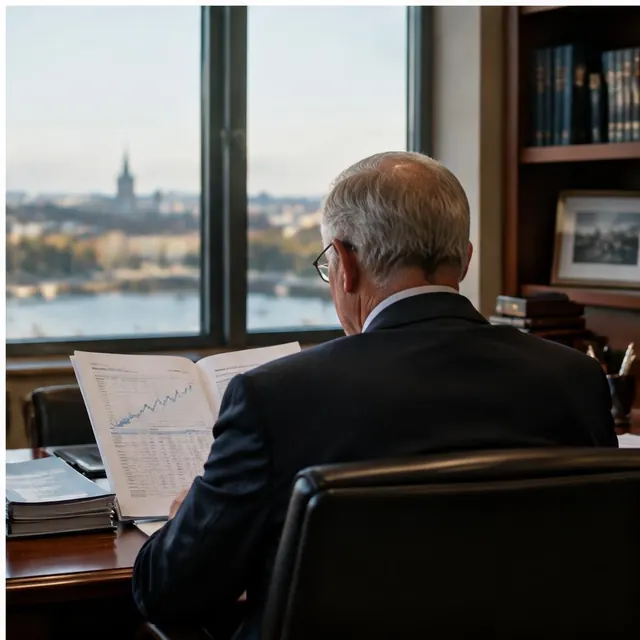
This morning, Warren Edward Buffett stepped down as chairman of Berkshire Hathaway — the final formal role connecting him to the company he has led for more than six decades. His son Howard will succeed him as non-executive chairman, guardian of the culture his father built. Greg Abel, who became CEO on 1 January 2026 following the announcement at Berkshire's May 2025 annual shareholder meeting, now leads the company Buffett took from a failing New England textile mill into a conglomerate with operating earnings of $44.5 billion in 2025 and nearly 400,000 employees worldwide.
In a letter to shareholders published today, Buffett wrote: "Father Time always wins. He has, however, been generous with me. He has given me the opportunity to see Berkshire reach a point where I am more confident than ever about what lies ahead." Abel said in a statement: "Warren's impact on Berkshire and its owners is without parallel in the history of American business."
The numbers that follow are the evidence for that statement. They are not disputed.
Omaha, 1930: The Beginning
Warren Edward Buffett was born in Omaha, Nebraska on 30 August 1930, the second of three children of Howard and Leila Buffett. His father Howard was a stockbroker who later served as a US Congressman — a household in which financial markets and public affairs were daily conversation rather than abstraction. The family was not wealthy in a material sense, but it was intellectually serious, and the combination of a father who understood markets and a mother who reinforced discipline and resilience shaped Buffett's early formation in ways that would not become visible to the wider world for decades.
The early commercial instincts are documented and verified. Buffett sold chewing gum and Coca-Cola door-to-door as a young child. He ran paper routes. He sold golf balls. He saved, reinvested and tracked the results. By the age of 11 he had purchased his first stock — three shares of Cities Service preferred at $38 per share. He watched the price drop to $27, waited patiently for it to recover to $40 and sold. The stock subsequently rose to $200. He described the experience, years later, as an early lesson in the cost of impatience — a lesson he would spend the rest of his career applying in reverse. By the age of 20 he had accumulated nearly $10,000 in savings through the combination of his early businesses, his paper routes and his stock investments.
Columbia and Graham: The Foundation
Buffett enrolled at the Wharton School of the University of Pennsylvania at 16 before transferring to the University of Nebraska, where he graduated while working full time. His application to Harvard Business School was rejected. He enrolled instead at Columbia Business School in New York, specifically because Benjamin Graham — the author of The Intelligent Investor and the intellectual architect of value investing — taught there. That decision, made because of a single man, changed everything.
Graham's framework — intrinsic value, margin of safety, Mr Market — gave Buffett a structured, repeatable analytical language for something he had been doing intuitively since childhood. The central idea was simple in concept and demanding in practice: a stock is not a ticker symbol or a price on a screen but a fractional ownership stake in a real business, and the question to ask about any investment is not what the market thinks it is worth today but what the underlying business is actually worth — and whether you are paying significantly less than that. Buy businesses at a discount to their intrinsic value, hold them, and let the business create the return. Patience is not an optional virtue in this framework. It is the mechanism.
After graduating from Columbia with a Master's in Economics, Buffett applied to work at Graham's firm, Graham-Newman Corporation. He was initially rejected. He eventually joined in 1954, earning $12,000 a year — a figure he later described as inconsequential compared to what he was learning. When Graham retired in 1956, Buffett returned to Omaha and founded Buffett Partnership Ltd. with $100 of his own money and $105,000 raised from family and friends. He was 25 years old. By the time he dissolved the partnership in 1969, its investors had earned a compounded annual return of 29.5%.
Berkshire: The Sixty-Year Build
In 1962, Buffett began buying shares in a struggling Massachusetts textile company called Berkshire Hathaway. By 1965, he had taken control. The textile business was in terminal decline — Buffett later acknowledged that the purchase of Berkshire was his biggest investment mistake, because he paid too much for a business with structurally poor economics. What he did with the mistake is the story.
Rather than simply trying to fix the textile operations, Buffett used the company's cash flow to acquire insurance businesses — a category he had identified as structurally attractive because insurance companies collect premiums before paying claims, generating what is known as "float": a pool of money that belongs to policyholders but is temporarily available for investment. GEICO, the auto insurer that Graham had first bought and that Buffett had studied since his Columbia days, became Berkshire's most significant insurance holding. The insurance float became the engine of Berkshire's investment machine — providing Buffett with a perpetual, low-cost or no-cost source of investable capital that allowed him to buy businesses and stocks in a way that other investors simply could not replicate.
He bought See's Candies in 1972 for $25 million. It has since generated over $2 billion in cumulative pre-tax earnings for Berkshire and taught Buffett the principle that he would articulate for the rest of his career — that a business with genuine pricing power and a durable competitive advantage is worth paying more than a strictly quantitative analysis might suggest. He invested in The Washington Post in 1973, accumulating a position worth approximately $11 million at cost that grew to over $1 billion. He bought a significant stake in Coca-Cola in 1988 for approximately $1.3 billion — a holding that, as of 2025, was worth over $24 billion in addition to the billions in dividends collected over the intervening decades. BNSF railway was acquired in 2009 for $26 billion — at the time the largest acquisition in Berkshire's history — in a bet on the durability of American freight rail infrastructure that reflected Buffett's consistent preference for businesses with physical, difficult-to-replicate competitive positions.
The performance of that portfolio, measured over six decades, is the central fact of Buffett's career. Berkshire Hathaway shares returned 5,502,284% between 1965 and the end of 2024, against the S&P 500's return of 39,054% over the same period. That equates to a compounded annual gain of 19.9% for Berkshire, against 10.4% for the S&P 500. A $100 investment in Berkshire in 1965 was worth $6.1 million by the end of 2025. The same $100 invested in the S&P 500 was worth $45,500. The arithmetic of compounding, sustained over sixty years, is what those numbers represent. Berkshire outperformed the S&P 500 in 40 of the 60 years between 1965 and 2024.
In recent years, as Berkshire's size has grown to a market capitalisation exceeding $1 trillion, the pace of outperformance has slowed. Between 2015 and 2025, the S&P 500 returned 304% against Berkshire's 234% — a natural consequence of managing capital at a scale where truly significant acquisitions are rare and where the largest growth opportunities in the market, in sectors like AI and semiconductors, have historically sat outside Buffett's stated circle of competence. He has acknowledged this directly in his own shareholder letters, noting that the company's scale now makes it structurally more difficult to replicate the returns of its earlier decades.
The Philosophy: What He Actually Believed
Buffett's investment philosophy is not complicated. It is simply difficult to maintain with consistency under the pressure of market cycles, media noise and the temptation to do something. His own articulation of it, across decades of annual shareholder letters — documents widely regarded as among the most instructive pieces of financial writing in the English language — returns to the same themes repeatedly.
Businesses, not stocks. A share of a business is an ownership interest in the revenues, profits and assets of a real enterprise. The price at which the market is willing to buy or sell that interest on any given day is largely irrelevant to the underlying value of the business. "In the short run, the market is a voting machine, but in the long run it is a weighing machine" — a formulation attributed to his mentor Graham that Buffett adopted and lived by.
Durable competitive advantage. The companies Buffett has held longest and profited most from — Coca-Cola, American Express, See's Candies, GEICO — all share the characteristic that their position in their market is difficult for competitors to attack. He called this a "moat."
The management of the businesses he owned. Buffett consistently operated Berkshire as a decentralised conglomerate in which subsidiary CEOs were trusted to run their businesses without interference, within a culture defined by the parent company's ethics rather than its operational directives. The culture was the control mechanism.
Price paid relative to value. The relationship between what you pay and what you get is the single most important variable in any investment outcome, and Buffett's career-long discipline in not overpaying — even for good businesses — was as central to his record as his skill in identifying quality. On market timing, his position was clear: "Our favourite holding period is forever." On market volatility: "Be fearful when others are greedy and greedy when others are fearful." On his own approach to learning: "I read 500 pages a day. That's how knowledge works. It builds up, like compound interest."
The Philanthropy: Giving Away a Fortune Larger Than His 2006 Net Worth
In 2006, Buffett announced a commitment to donate more than 99% of his wealth to philanthropy, making an initial pledge of 85% of his Berkshire shares to the Bill and Melinda Gates Foundation and four family charities. He described the commitment as one he felt strongly about, noting that the fortune he had accumulated had been built using "a market system that sometimes produces distorted results." The Giving Pledge — which he co-founded with Bill Gates and Melinda French Gates in 2010 — has encouraged hundreds of the world's wealthiest individuals to commit to giving the majority of their wealth away.
Since 2006, Buffett has donated more than $60 billion to charity, all in the form of Berkshire Hathaway shares. Earlier this year, in July 2026, he made his annual donation — $6 billion in Class B shares, his largest single annual donation — but for the first time in nineteen years, directed none of it to the Gates Foundation, redirecting the full allocation to foundations run by his children: the Susan Thompson Buffett Foundation, the Howard G. Buffett Foundation, the Sherwood Foundation and the NoVo Foundation. The remaining $140 billion worth of Berkshire shares will be distributed to those four foundations by 31 December 2034, in his own words "one way or another."
As Buffett himself noted, the total amount donated since 2006 is "substantially more than my entire net worth in 2006" — in 2006, his net worth was approximately $46 billion. The donations have already exceeded that figure by a substantial margin, making his lifetime giving one of the largest in recorded philanthropic history in absolute terms.
Berkshire After Buffett
Greg Abel, who became CEO on 1 January 2026, is a 64-year-old Canadian executive who spent seven years as Berkshire's Vice Chairman for Non-Insurance Operations before his appointment. Abel oversees the full operational range of Berkshire's businesses — BNSF railway, Berkshire Hathaway Energy, GEICO, See's Candies, Dairy Queen and the broader manufacturing, service and retail portfolio — alongside the investment operation that holds positions in Apple, American Express, Coca-Cola and, following a $10 billion private purchase in June 2026, Alphabet. Abel has committed in his first shareholder letter to maintaining Berkshire's decentralised model, its conservative balance sheet and its long-term investment orientation. "We maintain a fortress-like balance sheet, ensuring Berkshire's foundation is never compromised," he wrote.
Howard Buffett, Warren's son, becomes non-executive chairman — described by his father in the shareholder letter as the guardian of Berkshire's culture and values. "Greg runs the company; Howard will guard its culture and values — both worth more than anything on our balance sheet," Buffett wrote. "Think of Howard as a policy the shareholders own and hope never to claim against."
Buffett himself, at 96, remains in Omaha in the house he bought in 1958 for $31,500 and has lived in ever since.
The Bottom Line
Warren Buffett turned $100 and $105,000 raised from family and friends in 1956 into a company worth more than $1 trillion, compounding capital at 19.9% annually for sixty years against a market return of 10.4%, donating more than $60 billion to charity in the process and never, across six decades of annual shareholder letters, pretending the enterprise was anything other than what it was: a collection of good businesses, bought at reasonable prices, held for a long time, run by people who were trusted to do their jobs. He stepped down as CEO at the end of 2025. He stepped down as chairman this morning. The record stays.