A Name Over the Door
In February 2026, the Irish Times Business Awards gave its Distinguished Leader in Business award to a man who accepted it by video link from Monaco, in his 90th year. Sir Michael Smurfit sounded genuinely surprised. "I'm delighted to be receiving this award, which at this age of my life is very unexpected," he said. The rest of Irish business was less surprised, because the case for him has rarely been stronger than it is now.
Asked what he had left behind, he did not reach for sentiment. "The business is now run by my son Tony, it's nearly 100,000 people, operating in 45 countries with a turnover of $30 billion-plus and Ebitda of $5 billion-plus," he said. "From small, humble beginnings in Dublin, one simple factory that my father started, my legacy is the name of the company, well known and well respected and long may that continue." In one breath, it covers the journey from a single factory to a multinational.
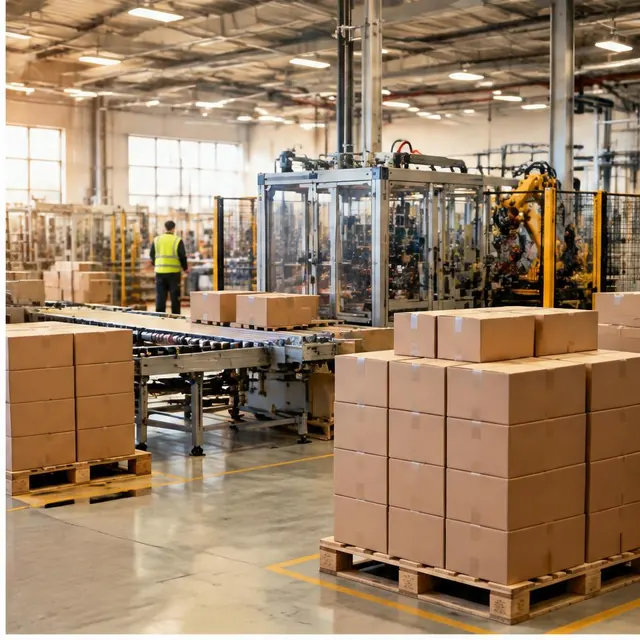
The company his father took on as a struggling Dublin box factory is now Smurfit Westrock, formed on 5 July 2024 when Smurfit Kappa and WestRock combined. It has its primary listing on the New York Stock Exchange and a secondary listing in London. It employs more than 97,000 people across more than 500 packaging facilities and 57 mills in 40 countries. In August 2026, the man who built it turned 90.
Poor, But Not in Poverty
The story begins not in Dublin but in St Helens, Lancashire, where Michael Smurfit was born on 7 August 1936. His father, John Jefferson Smurfit, was a tailor born in Sunderland. He took over a struggling Dublin box factory in which the family of his wife, Ann Magee, had a stake. The company was formed in Rathmines in 1934, and it was a modest beginning by any measure.
"I think you have to be able to understand poverty to be able to control riches," Smurfit has said. "We were not in poverty, we were poor." The distinction matters. It describes a family close enough to hardship to respect it, and ambitious enough to climb away from it.
He was educated at Clongowes Wood College in Co Kildare but left school at 15. His father told him plainly that he was not going to university, because it was time to make him a businessman. In 1955 he joined Jefferson Smurfit & Sons and learned papermaking from the bottom up. That apprenticeship gave him a working knowledge of the product that no lecture hall could have supplied.
Getting Out Before Getting Clobbered
The company floated on the Irish Stock Exchange in 1964 at a market value equivalent to about EUR 1.5 million. Michael was appointed joint managing director in 1967 and deputy chairman in 1969. By then he had identified the threat that would shape his career. The 1965 Anglo-Irish free trade agreement would open a protected home market to British competition.
"Back in the 1960s I could see that Irish industries were about to get clobbered," he later recalled. "We needed to get into new markets. I persuaded my father we should expand into England and America." That was not an obvious call for a family firm in a small economy. It was the right one, and it set the template for everything that followed: grow, or be swallowed.
The first great test came in 1970 with the acquisition of the Hely Group, a business four times the size of Jefferson Smurfit. He admitted afterwards that he "nearly died". The deal held, and it taught him how to take on something bigger than himself and make it work. When his father died in March 1977, Michael became chairman and chief executive of the Jefferson Smurfit Group.
America was tougher. "They used to look upon me as the Paddy over on the boat, chancing his luck," he said of his early reception. "It's a mistake they only made once." Not every lesson was cheap: the Alton Box Board Company in Illinois cost $74m, and an unrepaired factory roof cost a further $100m, "the single biggest business shock I've ever had". He absorbed the blow and kept building, and in 1985 Forbes named the group the number one company in the world ranked by earnings growth.
Merger by Merger to Smurfit Westrock
The 1998 merger with Chicago-based Stone Container Corporation gave the group real weight in the American market. He was named Global CEO of the Year in 1999. In 2002 he took the group private, retiring as chief executive in November that year while staying on as chairman.
The 2005 merger with Netherlands-based Kappa Packaging BV created Smurfit Kappa, with 42,000 employees in 33 countries. The company was refloated in 2007, the year he stepped down from it. Each step followed the logic he had set out in the 1960s. Go where the markets are, and build the scale to compete in them.
The 2024 combination with WestRock takes that logic to its conclusion. Under Tony Smurfit, President and CEO, the enlarged group reported net sales of $7,712m for the first quarter of 2026, with adjusted EBITDA of $1,076m at a 14.0% margin. It onboarded more than 600 new corrugated customers in that quarter alone. The second quarter, to 30 June 2026, brought net sales of $8,031m, adjusted EBITDA of $1,140m at a 14.2% margin, net cash from operating activities of $765m and a quarterly dividend of $0.4523 per share.
"I am pleased to report a strong second quarter performance," Tony Smurfit said. "In the two years since the formation of Smurfit Westrock, we have driven a significant cultural and operational shift in our business." It is the language of a company still in motion, which is exactly how his father ran it.
The K Club, the Ryder Cup and Irish Life Beyond Packaging
Smurfit's influence in Ireland never stopped at the factory gate. In 1987 his company acquired the K Club in Co Kildare, which he turned into a luxury hotel and golf resort. In 1991 he told his director of golf, David Adamson: "One day, David, the Ryder Cup will be here." In 2006 he brought the Ryder Cup to Ireland at the K Club, and the resort was sold for EUR 70 million in November 2019.
He served as chairman of the Racing Board and as the first chairman of Telecom Eireann. His name is also on the UCD Michael Smurfit Graduate Business School in Blackrock, which holds triple accreditation from AACSB, EQUIS and AMBA. For a man whose father sent him to work instead of university, it is a fitting monument. Irish managers now learn their trade under his name.
Queen Elizabeth II knighted him in 2005, awarding him a KBE for services to British business. France, Spain, Monaco and Colombia have also honoured him. He is honorary Irish consul to Monaco, and he told his own story in the autobiography A Life Worth Living.
He has also been a shrewd backer of other people. "I've made far more money outside of Smurfits than I did in Smurfits, backing people," he said in February 2026. "Denis O'Brien, for example, Dermot Desmond, John Magnier." It is a telling admission from a company builder: he recognised talent and was willing to put money behind it.
Those shrewd wagers on other people's talent helped build a fortune few Irish businessmen of his generation could rival. The 2010 Irish Independent Rich List ranked Smurfit 25th in Ireland, with personal wealth of EUR 368 million, and The Irish Times has since put his net worth at more than EUR 350 million. The figures matter less as numbers than as a measure of how far a packaging business had carried him. Today his home in Monaco is the Lady Ann Magee, a 50-metre, EUR 53 million superyacht named, tellingly, after his mother. Over twenty years he also assembled a 500-piece art collection, with works by Jack B. Yeats, Sir John Lavery, Sir William Orpen and Louis le Brocquy.
The Bottom Line
Sir Michael Smurfit now lives aboard the yacht Lady Ann Magee, named after his mother and moored in Monaco. He is candid that the Ireland of his working life has moved on. "I haven't been to Ireland for years. All the things I knew are gone," he said this year. The company he built, however, is still growing.
In August 2026 he marked his 90th birthday at the Hotel de Paris Monte-Carlo with around 150 guests, among them Prince Albert of Monaco. His son Tony gave a personal tribute. It was a family occasion and a business one too, because in the Smurfit story the two have never really been separate.
His one regret is stopping. "I hated retirement. I was totally unsuited to it. I retired probably 10 years too soon - and I've told my son Tony the same thing: work as long as you can," he said in 2022. That is the lesson for every Irish founder: think beyond your home market, take the hard deal, and do not leave the table early. From a box factory in Rathmines to a company listed on the New York Stock Exchange, Michael Smurfit showed how far that attitude can travel.