There are not many people in Ireland whose working lives connect the boardrooms of international manufacturing, economic research and the practical business of public infrastructure. Sean O’Driscoll is one of them. A former chairman and chief executive of Glen Dimplex, he brings experience of running a business that depends on factories, supply chains and reliable services. His contribution to Ireland’s infrastructure discussion starts with that practical perspective: an ambition matters most when somebody can turn it into something that works.
O’Driscoll is chair of the UCC Governing Authority and a member of the Government’s Accelerating Infrastructure Taskforce. He previously chaired the Economic and Social Research Institute, completing that term before his July 2026 appointment as chair of the Mid West Health Planning Board. Those roles place him at the meeting point of business, education, research and public delivery. They also explain why his views deserve attention beyond the construction industry or the planning profession.
The opportunity in his story is not simply that an experienced business leader has joined another public body. It is that the questions familiar to anybody who has built and run a company are being brought into the infrastructure conversation. Who is responsible for the next decision? What must happen before a project can move forward? And how will people know whether the promised improvement has actually arrived?
A Business Perspective on Public Delivery
Manufacturing gives a leader a particular understanding of infrastructure. A factory cannot operate on the strength of a strategy document alone; it needs electricity, water, transport connections and people who can reach work. An investment decision also depends on whether those services will remain dependable as the business grows. O’Driscoll’s Glen Dimplex background gives his involvement in public delivery a clear commercial relevance, without making private-sector experience a substitute for public accountability.
The two worlds have different responsibilities, and those differences matter. Government must balance competing needs, environmental protection, public spending and the rights of communities. But a shared discipline remains useful: identify the obstacle, make the decision at the appropriate level and follow through. The strongest contribution a business leader can make is not to pretend that every public project is simple, but to help make a complicated process more understandable and more accountable.
For Irish companies, that is a conversation with immediate value. A growing manufacturer may need a stronger grid connection, while a new housing development depends on water and wastewater capacity. Employers need transport networks that make recruitment and everyday commuting workable. These are connected requirements, not separate policy interests, and a delay in one can limit progress in the others.
From a Reform Plan to Visible Progress
The Government’s infrastructure action plan provides a framework for addressing those connections. Published in December 2025, it contains 30 actions; the programme also sets out 138 sub-actions with timeframes and responsible departments. At IMI’s National Leadership Summit on 1 October 2026, O’Driscoll reported that 77% of overall actions had been delivered by the previous day. That is his reported assessment of reform progress, not an independent audit or a count of completed construction projects.
The important question now is how those reforms are working in practice. A new procedure can be an achievement in its own right, but businesses and households ultimately need to see what it changes. Does an agency reach a decision sooner? Can a project promoter understand which approvals are needed, and in what order? Are the organisations involved working from a shared timetable rather than waiting for one another?
Progress should therefore be judged at more than one level. Completing a reform is different from securing consent for a project, and securing consent is different from putting infrastructure into service. Each is a necessary step, but none should be presented as the whole journey. That distinction allows the public to recognise real improvements while keeping attention on the delivery that still lies ahead.
Better Decisions, With Accountability Intact
Planning and legal processes are central to this discussion because they determine how proposals become decisions. The Critical Infrastructure Act was enacted on 25 June 2026, and the Government designated nine projects and programmes in July. These include MetroLink, Cork Area Commuter Rail, Greater Dublin Drainage and the North South Interconnector. Designation is intended to accelerate processing by public bodies; it does not amount to automatic planning approval or remove the need for a fair decision-making process.
For a business considering an expansion, predictability can be as important as speed. A timetable that changes repeatedly makes it harder to plan spending, recruit staff or explain an investment to a board. For a community, uncertainty can prolong concern and weaken confidence in the process. Clear decisions, made through a fair process and explained properly, serve both sides better than years of avoidable ambiguity.
This is where a delivery-focused leadership style can make a constructive difference. It asks whether requirements are proportionate, whether agencies have the resources to carry out their responsibilities and whether problems are being escalated to someone able to resolve them. It also recognises that a decision is only credible if the people affected can see how it was reached. Effective infrastructure leadership should strengthen public trust, not ask people to suspend it.
Water, Energy and the Everyday Economy
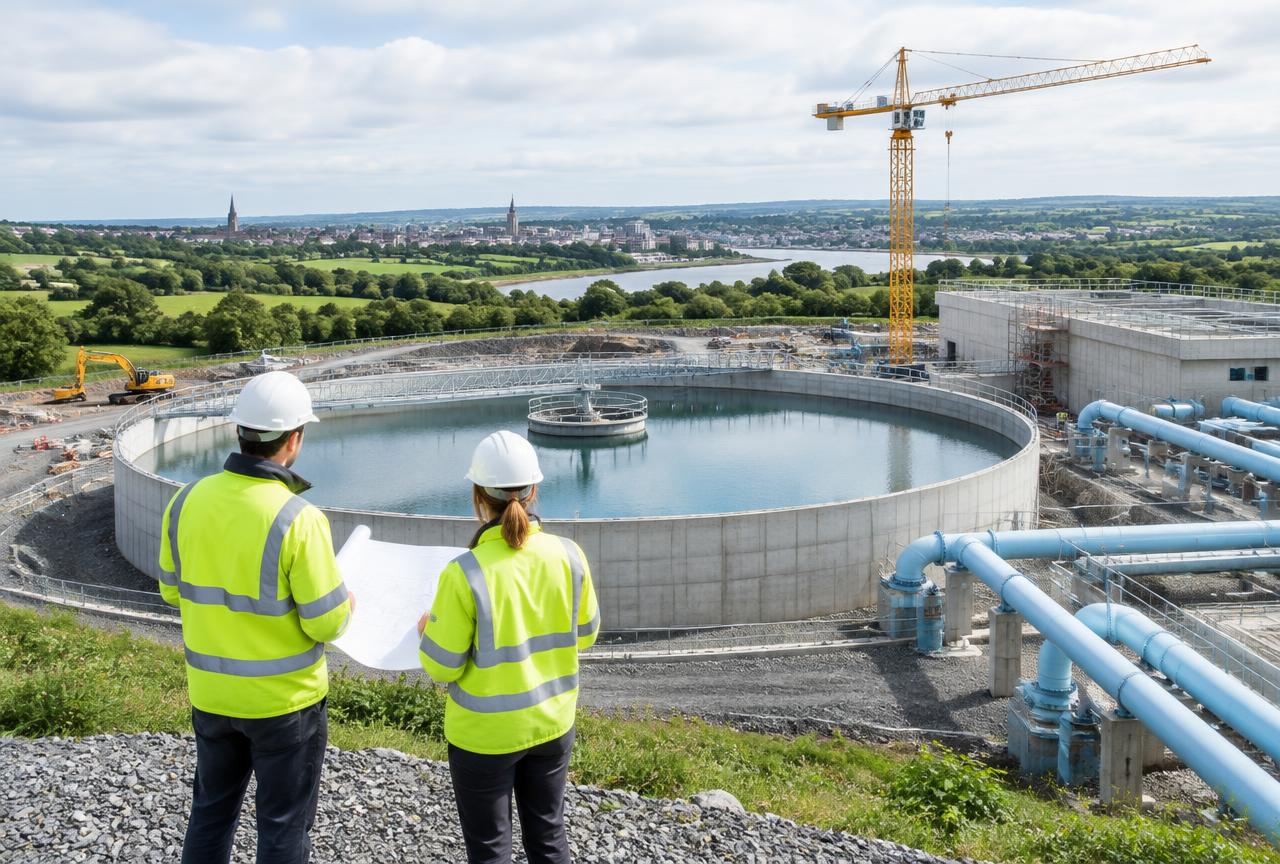
Water illustrates why infrastructure is an economic question as well as an engineering one. Housing, industry and public services all rely on dependable supply and wastewater treatment. Uisce Éireann’s proposed Water Supply Project for the Eastern and Midlands Region includes approximately 170 kilometres of treated-water pipeline and two kilometres of raw-water mains. Its scale underlines why the useful measure of progress is a clearer path from investment commitments to capacity people can actually use.
Energy presents a similar chain of dependencies. Renewable generation needs connections, networks need investment, and major projects need decisions that fit together. Business demand and household needs must be considered alongside security of supply and the transition to cleaner energy. Treating those requirements as one connected delivery challenge is more useful than discussing each in isolation.
Transport completes that everyday picture. Workers need practical journeys, businesses need dependable movement of goods, and expanding communities need connections to employment and services. Infrastructure can sound like a distant national programme until it is translated into those ordinary needs. A leadership approach rooted in delivery helps keep the conversation attached to the people and enterprises it is meant to support.
Leadership That Thinks Beyond the Next Announcement
O’Driscoll’s combination of commercial and public-governance experience makes this a Thought Leadership story rather than simply a report on government machinery. His UCC role connects him with an institution whose contribution extends across education, research and regional development. His previous ESRI chairmanship brought him into economic research, while his health-planning appointment adds another public-service dimension. Together, those responsibilities underline how closely infrastructure decisions are connected with the country’s wider future.
The positive case is that Ireland can bring that experience to bear on a practical programme of improvement. It does not require declaring every problem solved or assuming that reform will produce immediate results. It requires staying with the work after the announcement: checking progress, dealing with unresolved dependencies and making sure responsibility remains visible. That is a recognisable form of leadership for anyone who has had to deliver something difficult.
The Bottom Line
Sean O’Driscoll brings a credible business and governance perspective to Ireland’s infrastructure delivery effort. His taskforce membership sits alongside leadership roles in university and health planning, following his years at Glen Dimplex and the ESRI. The opportunity is to turn that experience into better coordination, clearer decisions and infrastructure that supports people and businesses over the long term. The next chapter should be judged not only by reforms announced, but by what those reforms enable Ireland to deliver.