Ireland lost one of its most consequential business leaders and philanthropists on Friday 4 July 2026, when Martin Naughton passed away at Harborview Medical Centre in Seattle, aged 87, while travelling in the United States with his beloved wife Carmel. He had built, from a factory with ten employees in Newry in 1973, a global manufacturing group with annual revenues in excess of two billion euro and more than 8,000 employees operating across 20 countries on four continents. He had given tens of millions of euro to education, the arts and community across Ireland, Northern Ireland, Britain, the United States and beyond. He had been honoured by Britain, France, the Vatican and the United States. And across all of it — the acquisitions, the expansion, the philanthropy, the international recognition — those who knew him returned to the same phrase: he was an absolute gentleman.
From Louth to Newry: The Beginning of Something Remarkable
Martin Naughton was born in Dublin and grew up in County Louth. He studied mechanical and production engineering at the Southampton College of Technology, qualifying as an engineer in 1961. He spent the following twelve years working as an industrial engineer and plant manager, gaining the operational understanding of manufacturing that would define his strategic instincts for the rest of his career. In 1973, with four colleagues, he founded Glen Electric in Newry — a small factory in a border town in Northern Ireland at the height of the Troubles, at a moment when establishing a new industrial business in that part of Ireland required not just commercial ambition but a particular kind of courage.
The founding in Newry was not incidental. It reflected something deliberate about the kind of businessman Naughton intended to be — one whose enterprise would operate across the border, serve both communities, and demonstrate through commercial practice that economic life could transcend the political and sectarian divisions of the time. As former Glen Dimplex CEO Sean O'Driscoll, who worked with Naughton for 26 years, later recalled: "He started out in Newry, but we had businesses in Bangor and Portadown too. Even at the height of the Troubles, we were able to operate without any issue whatsoever." That record of cross-community operating, maintained through years of conflict, earned Naughton recognition that went beyond the commercial — and contributed directly to his later being awarded a KBE from the then-Prince of Wales in 2015 for his contribution to peace and reconciliation on the island of Ireland.
The Glen Dimplex Story: An Audacious Acquisition and a Global Business
Four years after founding Glen Electric, Naughton made the decision that defined the company's subsequent trajectory. In 1977, Glen Electric acquired Dimplex — a UK company eight times its own size and a brand leader in electric heating. It was an audacious move by any measure: a four-year-old Irish company swallowing a much larger British competitor and emerging with a new combined identity, Glen Dimplex, that would eventually become the world's largest manufacturer of electrical heating products. The acquisition required courage, financing and a clarity of strategic vision that Naughton possessed in combination, and it set the pattern for how Glen Dimplex would grow for the following decades: organically and through well-chosen acquisitions of established brands with strong market positions, absorbed into a group that retained the character of a family-owned, private business throughout.
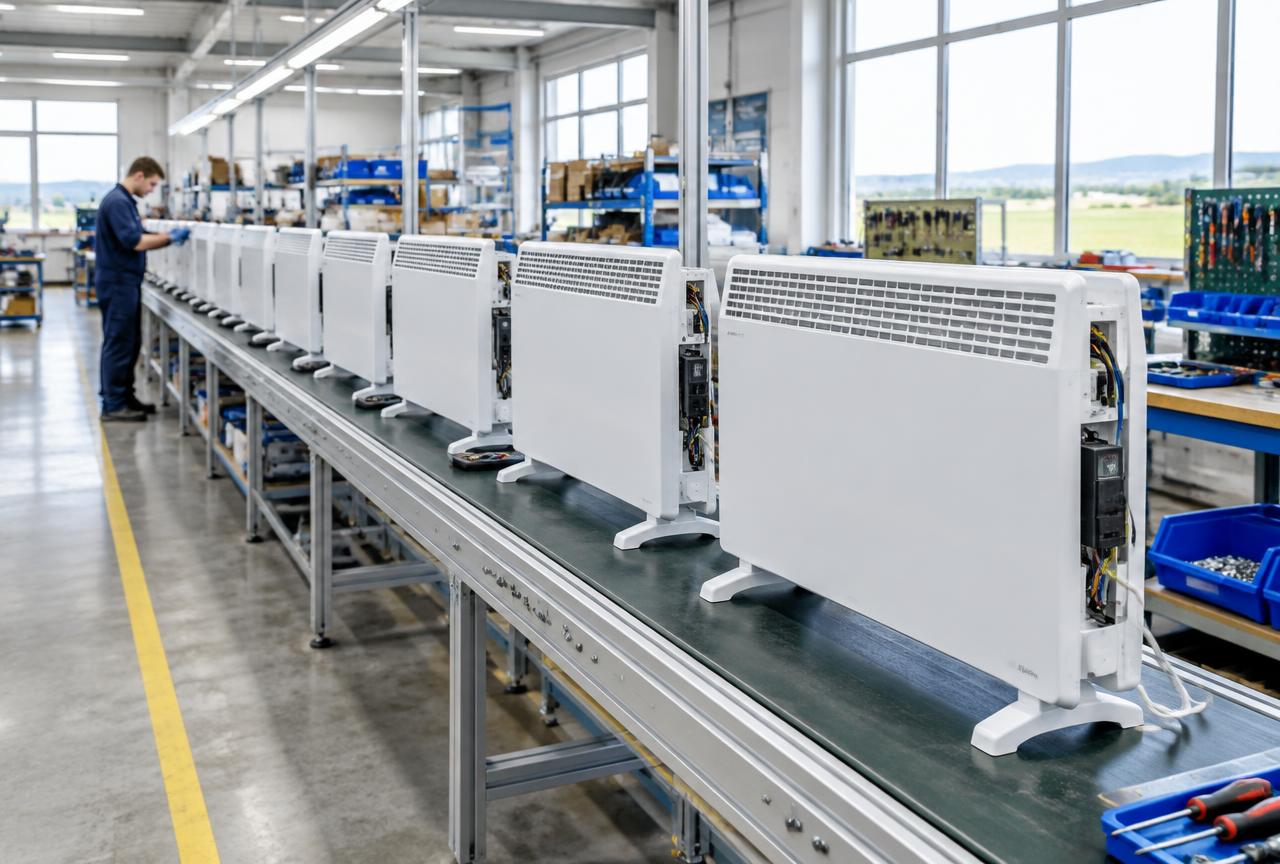
From that foundation in Newry and that first major acquisition in 1977, Glen Dimplex grew through successive decades of expansion across the United Kingdom, Europe, North America, Asia and Australasia. Today the group operates across four key sectors — Heating and Ventilation, Flame, Precision Cooling and Consumer Appliances — with a portfolio of brands that includes Dimplex, Belling, New World, Stoves, Morphy Richards, Rangemaster, AGA, Rayburn and Valor among many others. The acquisition of the Hyfra precision cooling business in Germany in 2023 extended the group's industrial cooling capability, and the group's global footprint now spans manufacturing facilities, sales operations and research and development centres across 20 countries. Glen Dimplex is a company with its name on millions of home and business appliances across the world, and most of the people who use those appliances never heard of Martin Naughton. That, in its own way, reflects the character of the man: a builder rather than a self-promoter, more interested in what was made than in who was seen to be making it.
Ibec CEO Danny McCoy described Naughton as one of Ireland's "greatest entrepreneurs whose vision, innovation and determination built a world-class Irish company." He showed, McCoy said, that an Irish manufacturing company could "compete, grow and lead on the world stage" — a demonstration that carried particular significance at a time when Irish indigenous manufacturing was fighting to establish an identity alongside the multinational FDI sector that was simultaneously transforming the Irish economy.
The Philanthropist: Education, the Arts and a Vision of Shared Opportunity
The Naughton Foundation was established in 1994, two decades after the founding of Glen Electric, and it became the formal expression of a philanthropic commitment that had been building since the business began to generate the resources to sustain it. The Foundation's focus was consistent and deliberate: education, particularly in the STEM disciplines, and the arts, particularly in Ireland and Northern Ireland.
The contributions to education were substantial and wide-ranging. In 2018, Martin and Carmel Naughton donated €25 million to Trinity College Dublin through the Naughton Foundation — a gift that Trinity Provost Dr Linda Doyle described as one whose legacy "will be felt for generations to come." The Foundation established the Naughton Scholarship programme, which supports Leaving Certificate students across every county in Ireland in pursuing STEM-related third-level education — a programme designed explicitly to extend opportunity beyond the students whose families had the financial resources to support higher education without assistance. Since 2008, the Foundation has offered scholarships to students pursuing STEM-related studies, reaching young people across the full geographic spread of the country rather than concentrating support on the major urban centres.
At the University of Notre Dame in the United States, Naughton's impact was transformative and enduring. He became a member of Notre Dame's Board of Trustees in 1999 and was central to the establishment of the Keough-Naughton Institute for Irish Studies — now part of Notre Dame's Keough School of Global Affairs and described as a world leader in the multidisciplinary field of Irish Studies. He helped make possible Notre Dame's establishment of a centre at the historic O'Connell House on Merrion Square in Dublin, and Notre Dame Kylemore at Kylemore Abbey in Connemara — two presences that have deepened the connections between Irish intellectual and cultural life and one of America's most prominent Catholic universities. The Naughton Fellowship Programme, which he created in 2008, funds a structured exchange of students in STEM fields between Notre Dame and Ireland's leading research universities, building relationships and research collaborations that have persisted long after individual students graduate.
In the arts, Naughton's generosity was equally significant and equally characteristic of someone who believed that culture was not a luxury but an essential component of a healthy society. In 2007, he donated £1 million to Belfast's Lyric Theatre — described at the time as the single biggest personal gift ever made to an arts organisation in Northern Ireland. The Lyric had been a vital cultural institution in a city that had lived through decades of conflict, and Naughton's gift came at a moment when the theatre was fighting for its future. Terry Neill, president of Wexford Festival Opera — itself another institution whose development Naughton supported — described him as "a philanthropist whose support, and as importantly, whose values, have had impact in nearly every dimension of Irish life." He also founded the Naughton Art Gallery and Museum at Queen's University Belfast, and was the main benefactor to the Lyric Theatre's rebuilding campaign, which produced the striking new building on the Stranmillis Road that the theatre now occupies.
The Honours: A Life Recognised Across Nations and Institutions
The scale of Martin Naughton's philanthropy and his contribution to peace and reconciliation brought recognition from multiple countries and institutions. He was appointed a Knight Commander of the Order of the British Empire in 2015 by the then-Prince of Wales. France awarded him the Officier de la Légion d'Honneur — one of that country's highest national distinctions. In 2025, Pope Francis conferred the Order of Saint Gregory the Great upon Martin and Carmel Naughton jointly, recognising their outstanding philanthropy in education and the arts, with particular acknowledgment of their support for Catholic education at Notre Dame and Kylemore Abbey and their contributions to higher education in Ireland. Notre Dame bestowed an honorary degree on Naughton in 1998. And through all of it, the man himself remained recognisably the same: direct, warm, generous with his time and his attention in a way that the formally successful are not always willing to be.
Sean O'Driscoll, who spent 26 years working alongside Naughton at Glen Dimplex, captured it most precisely: "Martin demonstrated the very nicest of people can also be phenomenally successful in business. He understood the difference between ownership and management and over 26 years we never had a cross word and I never got a negative word from him." The British Ambassador to Ireland, Kara Owen, spoke of his "significant personal contribution to peace and reconciliation." VentureWave co-founder Kieran McLoughlin, who worked with Naughton on his philanthropic activities, said: "Martin led a great life indeed. His vision, courage and example were tremendous. His generosity was extraordinary."
Minister for European Affairs Thomas Byrne described him as "one of Ireland's greatest industrialists and philanthropists" and noted that "countless students locally and nationally got their start through the Naughton Foundation." Ceann Comhairle Verona Murphy said Ireland had lost "not only a great entrepreneur, but a generous and compassionate citizen" who "embodied the Irish success story."
Survived By His Family and His Legacy
Martin Naughton is survived by his wife Carmel, their children Fiona, Neil and Fergal — who has led the Glen Dimplex Group and serves as a Hesburgh Trustee of Notre Dame — and their extended family. A celebration of his life took place at the Merrion Hotel in Dublin on Thursday 9 July, for family and friends who wished to mark the passing of a man who had been, across more than fifty years of Irish public and commercial life, a consistent and generous presence.
The Bottom Line
Martin Naughton built one of Ireland's most successful private manufacturing businesses from ten employees in a Newry factory to a global group with revenues in excess of two billion euro. He gave generously across education, the arts and community across two islands and two continents, in a manner that prioritised lasting impact over personal recognition. He was honoured by Britain, France and the Vatican. He was described, by those who worked beside him for decades, as an absolute gentleman. Ireland produced very few people like him. The loss is genuinely significant — and the legacy is real, and lasting, and will outlive the grief.