The Idea That Started With a Pandemic
Bobby Healy began his career writing video games for Nintendo at the age of 16. He went on to found Eland Technologies, an airline technology company he later sold, and then spent over a decade building CarTrawler into the largest mobility marketplace for airlines worldwide — a business that placed flight ancillary services infrastructure in the hands of carriers across the globe and demonstrated Healy's ability to build complex, regulated, aviation-adjacent technology at commercial scale. When Healy turned his attention to drone delivery in 2018, founding Manna, it was not his first time operating in a technically complex, heavily regulated sector with a long commercial development horizon. It would, however, prove to be his most publicly visible.
Manna was founded in 2019 by Bobby Healy, a Dublin-born entrepreneur who believed that short-distance delivery could be done faster and with far less carbon. The company's first significant public moment came not from a commercial delivery but from a healthcare one — during the first COVID-19 lockdown in 2020, Manna flew medication to isolated Irish residents who could not leave their homes. It was a small-scale demonstration of a use case — autonomous delivery of essential goods to people who cannot or should not travel — that would recur throughout the company's subsequent history and that framed its public positioning in a way that a coffee delivery from a shopping centre never quite could.
From Oranmore to Blanchardstown: The Irish Build
The company began with trials in Oranmore, County Galway, proving that it could deliver safely over small towns before moving to larger-scale operations in Blanchardstown. Those early Oranmore trials, conducted under close supervision and with the cooperation of the Irish Aviation Authority, established the basic operating model — autonomous quadcopters, managed by a single remote operator overseeing multiple aircraft simultaneously, carrying payloads of up to 4 kilograms to delivery addresses within a 3.4-kilometre radius.
Manna became the first LUC holder in Ireland after detailed scrutiny by the IAA of its safety procedures, including supervised trials. The LUC — Light UAS Operator Certificate — was a significant regulatory milestone, allowing Manna to operate without seeking prior approval of individual flight plans from the IAA and Irish air traffic control even in controlled airspace over Dublin. It was the first company in Europe to achieve this designation for suburban drone delivery, a technical and regulatory accomplishment that reflected both the sophistication of its safety systems and the willingness of the Irish Aviation Authority to engage constructively with a novel technology sector.
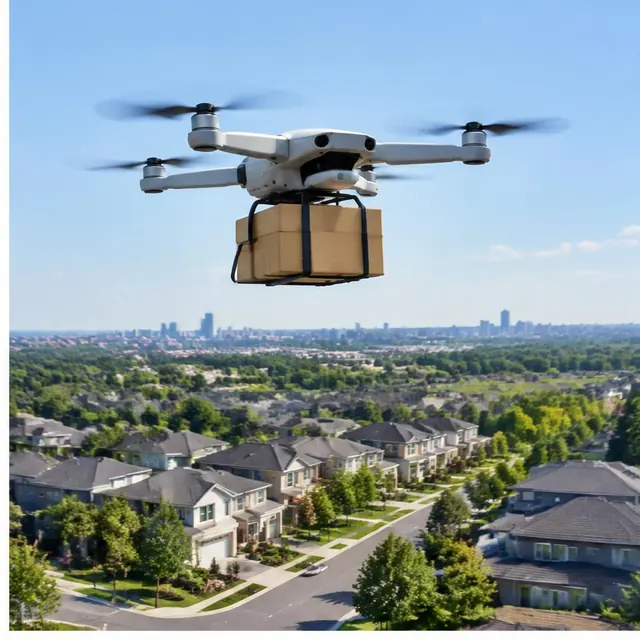
From a launch pad at Blanchardstown Shopping Centre, Manna has been flying small autonomous drones over the suburb since February 2024, dropping coffees, groceries and takeaway orders into gardens and driveways. The Blanchardstown operation grew to encompass 49 partner businesses and, at its peak, had become routine enough that many local residents no longer looked up when a drone passed overhead. Manna completed more than 60,000 deliveries from its hub in Dublin 15, and more than 300,000 deliveries in Ireland overall across six locations including operations in Cork and beyond Dublin. The aircraft and software were developed in Ireland, with many engineers drawn from Dublin City University. Manna reported 97.5% availability over a full year of Irish weather — a figure that addressed one of the most frequently raised objections to drone delivery in Ireland's climate. Each drone has eight motors, of which at least four are required for flight, with redundant flight computers, batteries and an emergency parachute.
The operational model was commercially lean. A single operator oversees up to 20 drones, enabling 80 deliveries daily per operator. Each flight was reported to be profitable on a per-delivery basis. The delivery fee for consumers was set at €1.99. Partners including Uber, Deliveroo and Just Eat were brought on as distribution channels alongside direct app orders through the Manna platform.
The Medical Dimension: Hospitals and Defibrillators
Alongside the commercial food and grocery delivery operations, Manna pursued a parallel track of healthcare-focused demonstration work that set it apart from most of its global drone delivery competitors. In 2024, the company participated in a simulation for the delivery of automated external defibrillators to community first responders — demonstrating that a drone could place an AED at the scene of a cardiac arrest in approximately two minutes, far ahead of average ambulance response times. The project was led by Dr Glenn Curtin with the HSE, National Ambulance Service and Community First Responders.
In March 2026, the Rotunda Hospital in Dublin and Manna teamed up to test the potential for rapid aerial transport of blood and other urgent medical materials, simulating a delivery to Connolly Hospital in Blanchardstown. "We've proven this technology works at scale. What we're showing now is how it can be applied in healthcare where minutes matter. Ireland is well-placed to lead the way, and this simulation is about building trust and momentum toward full integration," said Healy. The comparison with UK NHS trials was instructive: blood sample transport between Guy's Hospital and St Thomas' Hospital in London was reduced from more than 30 minutes by road to under two minutes by drone.
The Funding: $110 Million and a Notable Investor List
Manna's total funding reached approximately $110 million following its $50 million Series B financing announced in April 2026. The round was led by ARK Invest and Schooner Capital, with participation from the Ireland Strategic Investment Fund, Molten Ventures, Enterprise Ireland, Coca-Cola HBC and Tapestry. ARK Invest — the fund managed by Cathie Wood and known for backing companies including OpenAI, SpaceX, Tesla and Anthropic — described drone delivery as an emerging infrastructure opportunity. The ISIF's participation confirmed continued Irish state confidence in the company even as its domestic operations were coming under pressure. Earlier investors included Coca-Cola and Stripe's Patrick Collison.
The Planning Problem: How Ireland Lost Its Drone Company
The story of Manna's relationship with Irish planning authorities is the most consequential and most frustrating chapter of its Irish history — a sequence of events that, viewed in retrospect, traces the specific mechanism by which Ireland failed to retain the commercial operations of the company it had incubated.
The difficulties began accumulating in 2025. Fingal County Council refused planning retention for a Manna delivery hub at Junction 6 Castleknock in Dublin 15, ruling that the facility constituted an unauthorised development. Cork City Council's planning unit sent Manna warning letters raising concerns about its operation there. Community opposition, primarily focused on noise, grew at several proposed expansion sites. In June 2026, Dún Laoghaire-Rathdown County Council refused planning permission to Manna Drones Ltd for its planned hub on lands to the rear of Holy Cross Church in Dundrum.
The day after that refusal, Manna announced it would cease delivery operations in Ireland to concentrate its growth on the US, UK and other international markets. The company's statement was direct about the cause: "The lack of a clear national framework has left the sector reliant on local planning processes and created uncertainty around the infrastructure required to support drone delivery at scale." Healy's own statement was equally clear: "This is a difficult decision because Ireland is where Manna was founded, built and first proven. We are incredibly grateful to the communities, businesses, customers and employees who helped show that drone delivery can work at scale. However, in the absence of a clear national pathway to scale commercial drone delivery, we have to focus our investment in markets where that pathway is now clear."
Critics argued that Manna was turning its back on the country where it was founded. Healy pushed back on social media against what he described as "disingenuous commentators," noting that the specific and repeated planning refusals — combined with the absence of any national regulatory framework to resolve the resulting uncertainty — had made continued Irish operations commercially unsustainable. The chair of the Drone Action D15 community group in Blanchardstown, Seamus Doyle, welcomed the departure, saying residents' back gardens "will be enjoyable to sit out in once again." The contrast between those two responses — a founder frustrated by regulatory incoherence and a community group relieved by the withdrawal — illustrates the genuine difficulty that drone delivery in populated suburban areas presents for planning systems not designed for the technology.
Kenny Jacobs: The Aviation Executive Hired to Scale America
On 7 July 2026, four weeks after Manna grounded its Irish fleet, the company appointed Kenny Jacobs — former chief executive of DAA, the state operator of Dublin and Cork airports — as executive chairman and president. Jacobs had stepped down as DAA CEO in February 2026 after settling a lawsuit he had brought against the company following a rift with its board. Before DAA, he had served as Chief Marketing Officer of Ryanair during a period of significant commercial expansion and digital transformation, and had held senior roles with Tesco, Metro Group and MoneySuperMarket.
The appointment was notable for what it signalled as much as for what it delivered. Ireland's most significant drone delivery company had just hired the man who ran Ireland's airports — and his mandate was to grow the business everywhere except Ireland. Jacobs said on joining: "Manna is one of the most exciting companies coming out of Ireland in a generation. Bobby and the team have built world-leading drone delivery technology and the opportunity now is to expand and commercialise that across a variety of industries in the US, UK and other markets where policy and regulation are more advanced. I could not be more excited to join."
Healy's statement on Jacobs was equally specific about what the appointment was designed to provide: "Kenny is one of the few executives who has scaled aviation, retail and digital businesses internationally — and done so commercially. We are entering the most important phase in Manna's history, taking Irish-built technology to the markets where commercial drone delivery is now a reality. Having Kenny as executive chair and president will give Manna the experience at scaling up operations and commercial partnerships."
Tulsa, Oklahoma: The American Launch
On 8 July 2026, Manna launched its first full-scale metropolitan US operation in Tulsa, Oklahoma, establishing the city as its central operational base in the United States. Oklahoma's Governor Kevin Stitt attended the launch alongside Healy and Jacobs. Manna said 90% of residents in Tulsa would be able to order deliveries by autonomous drone within the next year, with the company planning to operate from 40 bases across the city by mid-2027. Each base requires only the area of approximately four car parking spaces — a capital efficiency advantage that Jacobs identified as central to the company's ability to scale rapidly across multiple cities.
Over the next three years, Manna expects to create more than 1,000 jobs in Tulsa — across aviation and flight operations, commercial operations, customer support, manufacturing, maintenance and business functions. Construction of a US manufacturing facility has already begun, with production expected to start in approximately a year. The operations team is being scaled to 200-300 people over the next 12 months.
Partners at launch include DoorDash, McDonald's and Uber Eats. Manna will compete in the US market against Zipline, Alphabet's Wing and Amazon's Prime Air — well-funded incumbents in a market that is now, following the Trump administration's regulatory acceleration, moving significantly faster than it was two years ago. Healy has noted that the FAA Administrator Bryan Bedford visited Manna's Dublin headquarters in January 2026 specifically to study its European operating model as the US Part 108 BVLOS rule — removing visual-line-of-sight requirements and allowing one operator to supervise multiple aircraft simultaneously — worked through the American regulatory system. Healy described the current US regulatory environment as providing the industry with "a turbo boost." "A company like us, we wouldn't have had any plans to grow in the United States until the environment was ready from a regulatory standpoint to start growth," he said. "We've decided very clearly that now is the time for us to put every penny we have into the USA."
The choice of Tulsa was deliberate. Oklahoma has a strong aerospace sector, significant aerospace manufacturing talent, and a governor actively seeking to bring jobs and headquarters to the state. The city had no major drone delivery operations prior to Manna's arrival, giving the company a clean market entry without the direct competition present in larger coastal metros. The Business Post has reported that Healy and Jacobs have described their ambition as becoming "the Ryanair of US drone delivery" — a framing that reflects both the scale of the market opportunity and the specific Irish commercial heritage that both men bring to the attempt.
The Irish Times reported in early August 2026 that the Tulsa launch had not been without its own community friction, with some residents learning about the new drone operations through a friend's advertisement rather than direct notification — echoing, in a different regulatory context, precisely the kind of community relations challenge that contributed to Manna's planning difficulties in Dublin.
What Remains in Ireland
Manna's commercial delivery operations in Ireland have ceased. Its research, administrative and manufacturing operations — and its headquarters — remain in Dublin. The aircraft and software that will power its American and international expansion were built in Ireland and are still being developed here. The company has described Ireland as "the foundation of everything we do" — a framing that was part of the messaging around its April $50 million funding round, even as the trajectory toward an Irish operational exit was already clear. Whether Ireland's planning and regulatory system will develop, in time, the national framework that would allow a company like Manna to operate at commercial scale here again is the question that the departure leaves open.
The Bottom Line
Manna built a drone delivery operation in Ireland that completed more than 300,000 deliveries, proved the technology worked at commercial scale in suburban conditions, flew in temperatures and weather that no competitor had managed, pioneered medical simulation deliveries and attracted $110 million in investment from some of the world's most credible technology investors. It then ran into a planning system that could not accommodate it, exited Irish operations in June 2026 and launched in Tulsa, Oklahoma in July with Kenny Jacobs as executive chairman and a mandate to scale across the American south-west. The technology was built in Ireland. The commercial future is being built elsewhere. The gap between those two sentences is the story Ireland's drone policy will be asked to account for.