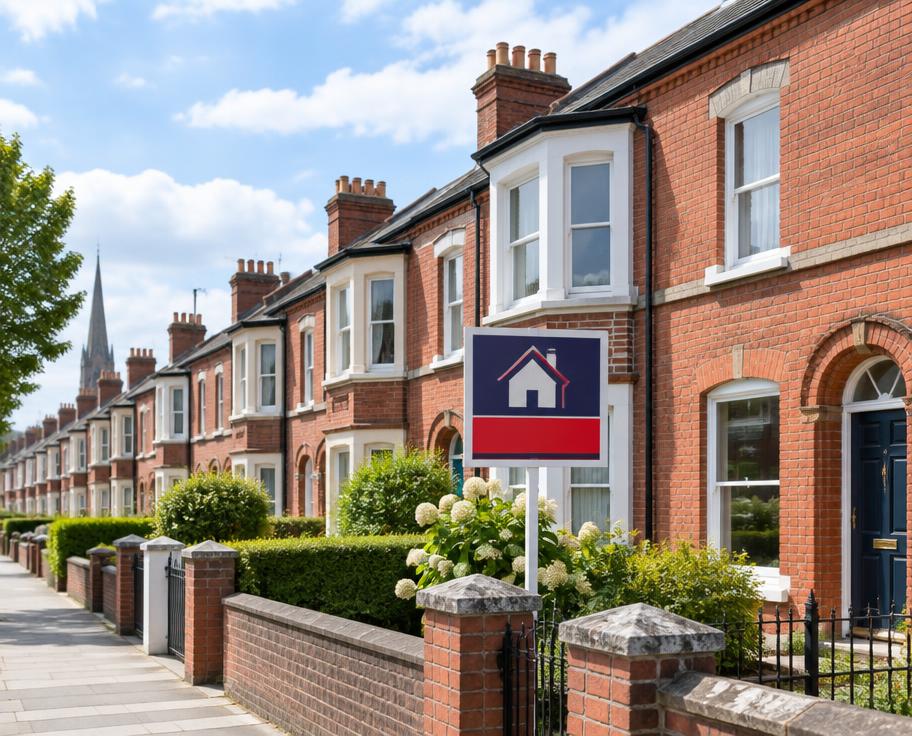
Ireland's economy is generating jobs at a pace that its housing stock cannot support. That mismatch — between the demand that a growing, fully employed economy creates and the supply that a structurally constrained construction sector can deliver — has moved from social policy concern to the defining competitiveness challenge of 2026.
The numbers are stark. Residential property prices rose 7 per cent nationally in the twelve months to January 2026, according to the CSO. The median price paid for a home in Ireland in the year to February 2026 was €390,000. In Dublin, the median was €500,000. In Dún Laoghaire-Rathdown, the most expensive part of the capital, the median reached €681,500. Average rents in Dublin stand at €2,165 per month — against a national average of €1,336 — based on Q4 2025 CSO and Residential Tenancies Board data.
These are not abstract statistics. They are the operational reality faced by every Irish business trying to hire, retain and relocate staff in 2026.
What Business Leaders Are Saying
The business community's position on housing has hardened significantly. This is no longer a background concern — it is a front-line operational problem.
Research by S&W found that 68 per cent of Irish business owners say the housing shortage directly influences where they choose to locate offices. Almost half of surveyed businesses said they have had to offer higher salaries or housing allowances to attract workers. Forty-three per cent reported losing potential hires because of housing costs. Seven in ten respondents said the shortage is now a major constraint on business expansion.
S&W Managing Partner John O'Callaghan put it directly: "Specific policy interventions, particularly around housing and infrastructure, are now essential to unlock the country's full economic potential."
The problem is not confined to smaller businesses. Grant Thornton Ireland's managing partner Michael McAteer has noted that between 25 and 30 per cent of international recruits who accepted positions with the firm subsequently cancelled after researching Ireland's housing market.
Chartered Accountants Ireland research found that one in four businesses had lost employees or seen prospective employees unable to accept roles because of the unavailability of affordable housing.
The Supply Gap
Ireland needs approximately 52,000 new homes annually to meet demand, according to the Central Bank of Ireland. Actual completions in 2025 are estimated at approximately 33,000. The ESRI projects approximately 37,000 completions in 2026 — meaningful progress, but still well short of what the economy requires.
The ESRI's research director Alan Barrett has warned that Ireland is no longer limited by funding for housing delivery but by labour capacity in the construction sector. ESRI research director Conor O'Toole has stated that resolving capacity shortages in housing is essential to sustain long-term economic growth.
Property prices nationally have increased by 179 per cent from their trough in early 2013, according to CSO data. Market rents nationally are 34 per cent above pre-COVID levels, according to Ronan Lyons, Associate Professor in Economics at Trinity College Dublin. "Slower growth rates do not signal balance," Lyons said. "They reflect the fact that rents have already risen sharply."
The Competitiveness Dimension
The Central Bank of Ireland has stated explicitly that prolonging the imbalance between housing demand and supply increases the cost of living and in turn the cost of doing business, ultimately damaging competitiveness over the medium term.
IDA Ireland's own internal briefing has identified housing as one of the critical infrastructure areas Ireland must address to remain competitive for foreign direct investment. The IDA's 2025-2029 strategy places infrastructure — including housing — alongside energy and transport as the determinants of Ireland's next investment cycle.
The logic is straightforward. When workers cannot afford to live near their jobs, wages must rise to compensate. When wages rise to compensate for housing costs, Ireland's cost base increases relative to competing locations. When the cost base increases, the investment proposition weakens. The chain from housing unaffordability to reduced competitiveness is not theoretical — it is the operational experience of thousands of Irish businesses in 2026.
The Bottom Line
Ireland's economic fundamentals remain strong. Employment is high, enterprise activity is growing and the country retains genuine advantages in talent, regulation and EU access that competitors cannot easily replicate.
But an economy that cannot house its workforce is an economy that will struggle to grow at the pace its ambition demands. The Government's target of 300,000 new homes by 2030 under the National Development Plan is the right ambition. Delivering it — at the pace and scale required — is the most important economic policy challenge Ireland faces. Everything else follows from it.