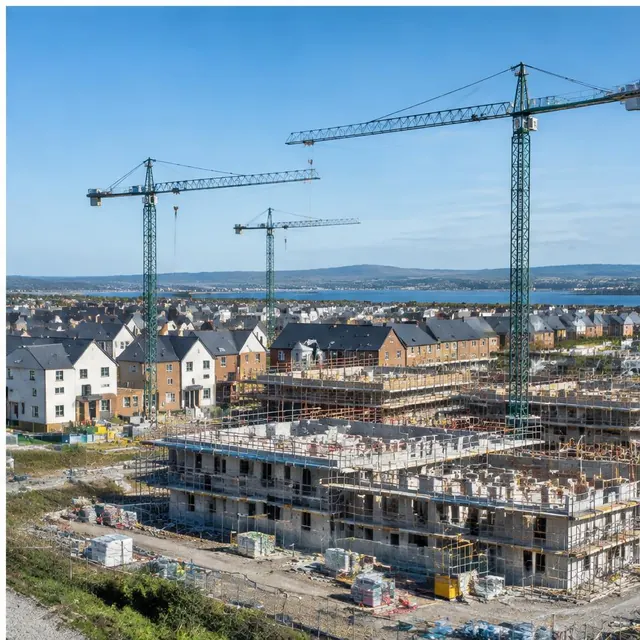
Glenveagh Properties PLC is a publicly listed Irish homebuilder headquartered in Maynooth, County Kildare, and traded on Euronext Dublin under the ticker GLV. Founded in 2003, the company constructs and sells houses and apartments across two principal business lines: a Homebuilding division focused on own-door single-family properties primarily in Dublin, the Greater Dublin Area and Cork; and a Partnerships division that delivers suburban and urban residential developments for State bodies, local authorities, housing associations and the private rental sector across Ireland. As of its full-year 2025 results, published on 13 March 2026, Glenveagh's market capitalisation stood at approximately €1.21 billion, placing it firmly in the mid-cap tier of the Irish Stock Exchange and making it one of the largest property companies by market value on Euronext Dublin.
The company is led by CEO Stephen Garvey, who has been the driving operational force behind its growth strategy and whose personal holding — 10,053,558 shares as at the latest available data — reflects a meaningful alignment between leadership and shareholder interest. The largest single institutional shareholder is Teleios Capital Partners LLC, a US-based investment firm which holds a 23.1% stake, followed by Fidelity International at 9.29% and Helikon Investments Limited at 7.66%. GIC Private Limited, the sovereign wealth fund of Singapore, holds 5.06%. Institutional investors collectively account for approximately 48.7% of the share register, with hedge funds holding a further 30.7% — a shareholder composition that reflects significant interest from international institutional capital in Ireland's residential property market.
The Financial Record: Revenue, Profit and Capital Returns
Glenveagh's 2025 full-year results confirmed a business operating at scale and delivering consistent financial progress. Group revenue reached a record €926 million in 2025, up 7% from €869 million in 2024. Profit before tax increased 11% to €125 million from €113 million. Earnings per share rose 18% to 20 cent from 17 cent the previous year, ahead of analyst expectations. Group gross margin improved to 21.4% from 21.2%, underpinned by what the company describes as its manufacturing-led, vertically integrated delivery model — a production approach that uses timber frame and light gauge steel construction as standard, reducing reliance on traditional on-site wet trades and improving cost predictability across the build programme.
Total group completions reached 2,568 homes in 2025, up 11% from the 2,309 homes delivered in 2024 — a year-on-year increase that reflected strong Partnerships performance even as Homebuilding completions came in slightly below the prior year, reflecting the ramp-up of new sites acquired in late 2024 that absorbed build capacity during 2025 and are expected to begin contributing to completions from 2026 onward. The company's first development in County Laois, comprising 195 units, sold out within ten months — a signal of the depth of demand for affordably priced homes in regional markets outside Dublin. Demand remained particularly strong for Help to Buy qualifying homes priced below €500,000.
The capital returns programme has been a consistent and meaningful feature of Glenveagh's financial story. In the period since 2021, the company has returned approximately €445 million to shareholders through share buybacks — a figure that represents a significant proportion of its current market capitalisation and that reflects the cash-generative nature of the business model at scale. The most recent €105 million buyback programme was completed alongside the full-year 2025 results, with a further €25 million programme announced immediately after.
The Partnerships Division: The State as Strategic Partner
One of the defining structural features of Glenveagh's business model is the scale of its Partnerships division — which by 2025 accounted for more than 40% of group business and delivered revenues of €380.9 million, up 61% year on year from €237.3 million. The Partnerships division works with State bodies, local authorities, housing associations and the Land Development Agency to deliver residential developments that combine affordable, social and cost-rental homes at scale. The division's clients include State entities and government-backed organisations for whom Glenveagh's track record, scale and planning capability make it a natural delivery partner for the public sector's most ambitious housing programmes.
Among the active Partnerships projects are the LDA-backed Cork Docklands development, Oscar Traynor Road, Foxwood Barn and Semple Woods, alongside new sites at Mooretown and New Road. The Partnerships division is guided by a target annual average gross profit of €60 million and is expected to maintain that contribution in 2026 and beyond. The 61% revenue growth in 2025 reflects both the scale of projects moving to completion and the deepening of Glenveagh's relationships with public sector delivery partners — a track record it describes as "repeat mandates from State-sector partners."
Planning and Land: The Competitive Moat
One of the most specific and verifiable competitive advantages that Glenveagh has built is its planning approval record. CEO Stephen Garvey has noted that the company's planning approval rate over the last five years is well above the national average, with only one refusal across a large number of applications — a record that reflects both the quality of its planning submissions and the sustained relationships it has built with local authorities across Ireland. In a planning environment that the company has described as "one of the most significant reforms in a generation" following recent legislative changes, Glenveagh's internal planning capability gives it both a speed advantage and a cost efficiency that smaller housebuilders operating without the same in-house resource cannot match.
The company's land bank is central to its medium and long-term delivery outlook. Garvey has described it as "probably the best land bank in the country today" in terms of deliverable, zoned land — a positioning that underpins the company's guidance that output will reach approximately 3,600 units by 2028 and that 80% of 2026 costs and 50% of 2027 costs were already procured at the time of the March 2026 results. All 2026 deliveries had already commenced construction at the time of reporting, and the 2027 programme is either in planning or progressing through active applications. Glenveagh has also been actively optimising its land portfolio through selective disposals — completing €55 million of land sales in 2025, up from €23 million in 2024, and targeting up to €100 million across 2025 and 2026 combined.
Reputation: Customer Satisfaction and Market Position
Glenveagh's 2025 annual report confirmed a 95% customer satisfaction rating across its homebuilding operations — a figure that the company cites as a direct output of its standardised, manufacturing-led approach to construction, which improves build consistency and reduces the defect rates that have historically been a source of customer dissatisfaction in the Irish new-homes market. The company's vertically integrated delivery model — which now embeds timber frame and light gauge steel manufacturing fully across the platform — is being further developed through targeted investment in 2026 and 2027, specifically to increase pre-manufactured value, improve cost control and enhance build certainty as the company scales toward 3,600 units per year.
Deutsche Bank upgraded Glenveagh to "buy" from "hold" in 2026, reflecting confidence in the company's earnings trajectory and the supportive fundamentals of the Irish housing market. The company enters the second half of 2026 guiding EPS of up to 21 cent for the full year, with Homebuilding gross margin expected to remain above 21%, total completions of approximately 2,750 units and a forward order book of €1.1 billion providing high visibility on delivery and earnings.
The Irish Housing Context
Glenveagh operates in a market where structural demand for housing continues to significantly outstrip supply. Annual housing output nationally is currently running at approximately 36,000 units, against government targets and independent assessments that point to a requirement of between 50,000 and 60,000 units per year to meet population growth, household formation and the replacement of ageing and obsolete stock. Garvey has been direct in describing this as a "pivotal moment" for Irish housing, noting that "Glenveagh has the land, capability and capital to deliver high-quality homes at scale, and we are ready to play a leading role." The government's support for demand-side schemes — Help to Buy, the First Home Scheme, the Affordable Homes Scheme — has directly benefited Glenveagh's sales pipeline, with the company making Affordable Homes Scheme properties available across six developments in 2025.
The recent planning reforms, described by Glenveagh's management as the most significant in a generation, are improving approval timelines, removing delay mechanisms and increasing certainty for applicants — changes that benefit well-resourced, experienced operators like Glenveagh more than smaller competitors without the in-house planning capability to exploit the reformed system efficiently.
The Bottom Line
Glenveagh Properties has built a consistent and well-capitalised business at the centre of Ireland's housing supply challenge — delivering record revenue of €926 million and 2,568 homes in 2025, returning €445 million to shareholders since 2021, maintaining a 95% customer satisfaction rating and building toward 3,600 annual completions by 2028. With a market capitalisation of €1.21 billion, a €1.1 billion forward order book and a land bank that its own CEO describes as probably the best in the country, the company is positioned to remain a significant and growing force in Irish residential construction for the rest of this decade.