A Festival That Has Outlasted Almost Everything
The Galway International Oyster and Seafood Festival opened this weekend at the end of September in its 72nd year — billed by its organisers as the oldest oyster festival in the world and one of Europe's longest-established food events. It began in 1954 when Brian Collins, then manager of the Great Southern Hotel in Galway, invited a small group of people to celebrate the opening of the oyster season with a dinner at Clarinbridge, a small village on the southern shores of Galway Bay where native oysters have been harvested for centuries. What was essentially a trade promotion for Galway Bay oysters became, over the following seven decades, one of the most recognised food festivals in the world — attracting visitors from across Europe, North America and beyond who come specifically for the combination of the oysters, the music, the atmosphere and the particular west of Ireland experience that only Galway in late September provides.
The first edition was a modest affair — thirty-four guests at a festival banquet organised with the help of Guinness and Patrick M. Burke's Bar in Clarenbridge, held at Clarinbridge by day and in the Great Southern Hotel by night. The scale has changed out of all recognition, but the shape of the idea has not. This year's festival ran from Friday 25 September to Sunday 27 September: the official opening, oyster farm tours and the Irish Oyster Opening Championship on Friday, the World Oyster Opening Championship at the centre of Saturday, and the pubs and venues of the city carrying the music through Sunday night. The programme has evolved with the times — the oyster trail, the official festival brunch and the Parade of Flags out of Eyre Square now sit alongside the competition — but attendance has never been the festival's problem. Third-party coverage over the decades has put the annual crowds anywhere from over ten thousand to upwards of twenty thousand visitors in a single September, and the festival's tourism partners count well over half a million visitors through the gates since 1954.
The festival runs across the last weekend of September and draws tens of thousands of visitors to Galway annually. The format has evolved but the core remains consistent: the World Oyster Opening Championship, in which competitors from countries across the globe race to open oysters as quickly and cleanly as possible — a skill that takes years to develop and produces results that astonish watching crowds; the festival brunch and the Parade of Flags; and the continuous programme of live music and entertainment that fills the city's streets, pubs and venues from Friday evening to Sunday night.
The Oyster Itself
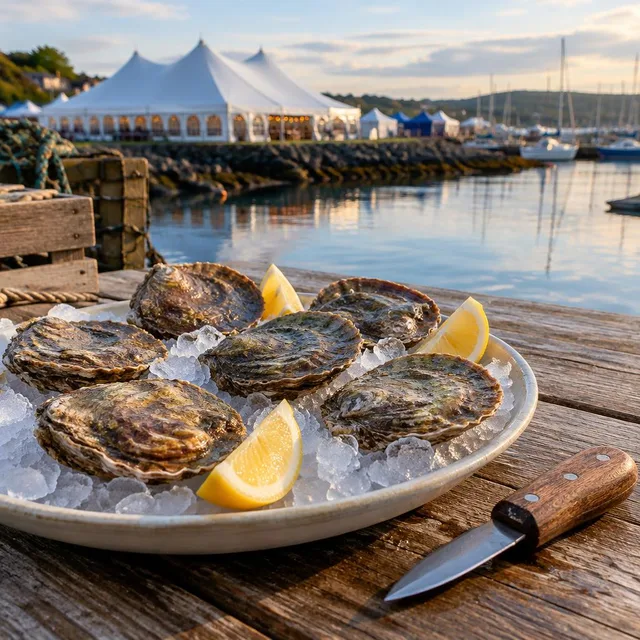
The Galway Bay native oyster — Ostrea edulis — is the foundation on which the festival was built and the product that gives it its specific character. Native oysters are biologically and commercially distinct from the Pacific oysters that dominate most oyster production globally. They are rounder, flatter, slower-growing and more intensely flavoured — with a mineral, briny, almost metallic character that regular oyster eaters describe as more complex and more challenging than Pacific varieties. They take between three and five years to reach market size, compared to two to three years for Pacific oysters, and they are considerably more difficult to farm commercially because of their sensitivity to water temperature, salinity and disease pressure.
Galway Bay's cold, clean Atlantic water — the tidal exchange between the bay and the open ocean bringing constant nutrient-rich oxygenated water across the oyster beds — provides conditions that produce oysters of particular quality, and the Clarinbridge and Moran's of the Weir oyster beds, which have been worked by the same families for generations, are among the most historically significant oyster producing sites in Ireland. Eating a Galway Bay native oyster from a bed that has been in continuous production for a century, on the shores of the bay in late September, is one of those specifically placed food experiences that cannot be replicated anywhere else.
That history is documented, not folklore. Moran's Oyster Cottage at the Weir, just outside Kilcolgan, has served from the same thatched building since the 1760s, when Daniel Moran took out a licence for the pub — though it only became the seafood institution it is today in the mid-1960s, and it remains in the hands of the sixth generation of the same family. Local heritage accounts describe the Clarinbridge and Dunbulcaun shore beds as one of the few places in Europe whose native oyster fishery survived the wholesale over-fishing of the nineteenth century, with 150 to 200 boats once working the bay. A Heritage Council-funded audit of the native oyster in Galway Bay catalogued that heritage — environmental, cultural, social and economic — and the picture it draws is of a fishery that has outlasted almost everything around it.
The World Oyster Opening Championship
The competitive heart of the festival is the World Oyster Opening Championship — a timed, judged competition in which competitors must open 30 oysters as quickly and as cleanly as possible, with marks deducted for broken shells, damaged oyster meat and presentation failures. The skill required is considerable: a professional oyster opener can complete 30 oysters in under three minutes, and the best competitors in the world championship are working at speeds that make the technique almost invisible to a watching crowd.
National champions from more than a dozen countries compete for the world title — France, the United States, Canada, Norway and Ireland among the traditional strongholds, with around sixteen nations represented at this year's championships and Singapore among the countries flying in for it. The competition has been won by Irish competitors in multiple years: Vincent Graham in 1989 and 1995, Gerry Grealish in 1991, 1993 and 1996, Michael Moran in 2006 and 2012, and Stephan Nolan in 2019. That record is a reflection of both the depth of the oyster farming tradition in Ireland and the specific advantage of growing up working on oyster beds — and Moran's own route to the top, as champion of the Kilcolgan beds he works, is the whole story of the festival in one career.
An Industry Behind the Shell
It is worth remembering, seventy-two years on, that the festival began as trade promotion — and that the trade it was promoting is still there. The native oyster season on the west coast opens in September, which is why the festival sits where it does in the calendar, and the beds of Galway Bay remain a working fishery as well as a cultural landmark. The weeks around the festival are the oyster trade's own trade fair: buyers, chefs and restaurateurs from across Ireland and Europe arrive with the visitors, the city's restaurants build their menus around the season's first landings, and the hospitality economy of Galway gets its last great weekend of the year before the autumn.
The commercial point has not changed since Brian Collins put oysters on the menu in 1954: you cannot sell what people have never tasted, and you cannot replicate the taste of a native oyster grown in the bay it was eaten beside. That is why the festival has survived when so many heritage food events have quietly disappeared — it is not celebrating a memory, it is selling the opening of a season that genuinely begins each September, with a product that only exists here in this form.
Clifden Arts Festival: The Culture Counterpoint
Running concurrently with the final days of the Oyster Festival, the Clifden Arts Festival in Connemara — which runs from 17 to 27 September — provides the cultural counterpoint to Galway city's food and music weekend. Now in its 49th year, the Clifden Arts Festival is Ireland's longest-running community arts festival, bringing writers, musicians, visual artists and performers to the heart of Connemara while remaining rooted in the region's distinctive cultural identity. The combination of the Oyster Festival in Galway city and the Clifden Arts Festival in Connemara makes the last week of September one of the richest cultural weekends in the west of Ireland calendar.
The Saltwater Festival: Surf and Community
Completing the September coastal picture, the Saltwater Festival — which opened in Bundoran, County Donegal on 24 September and runs on until 4 October — celebrates Ireland's surf culture with competitions, beach sports, local food experiences, film screenings and a music trail along the Wild Atlantic Way. This year's festival is built around the European Junior Surfing Championships, held at Bundoran's famous breaks, which brings young surfers from across the continent to the northwest coast at the exact moment the Atlantic swells return. The festival reflects the growth of surf culture in the northwest of Ireland over the past decade, with Bundoran in Donegal and Strandhill in Sligo both having developed surf communities and supporting infrastructure that attract surfers from across Ireland and Europe throughout the summer and autumn season.
The Bottom Line
The Galway International Oyster and Seafood Festival at 72 is not a heritage event preserved in amber — it is a living, growing, internationally recognised food festival that continues to draw tens of thousands of visitors to Galway in late September for reasons that have not changed since 1954: the oysters are genuinely excellent, the music is genuine, the atmosphere is specific to this city in this season, and there is nowhere else in the world where you can eat a native Galway Bay oyster on the shore of the bay where it was grown while listening to a trad session that has been going since midday. That combination is not replicable, and more than seven decades of people finding their way to it is the evidence.