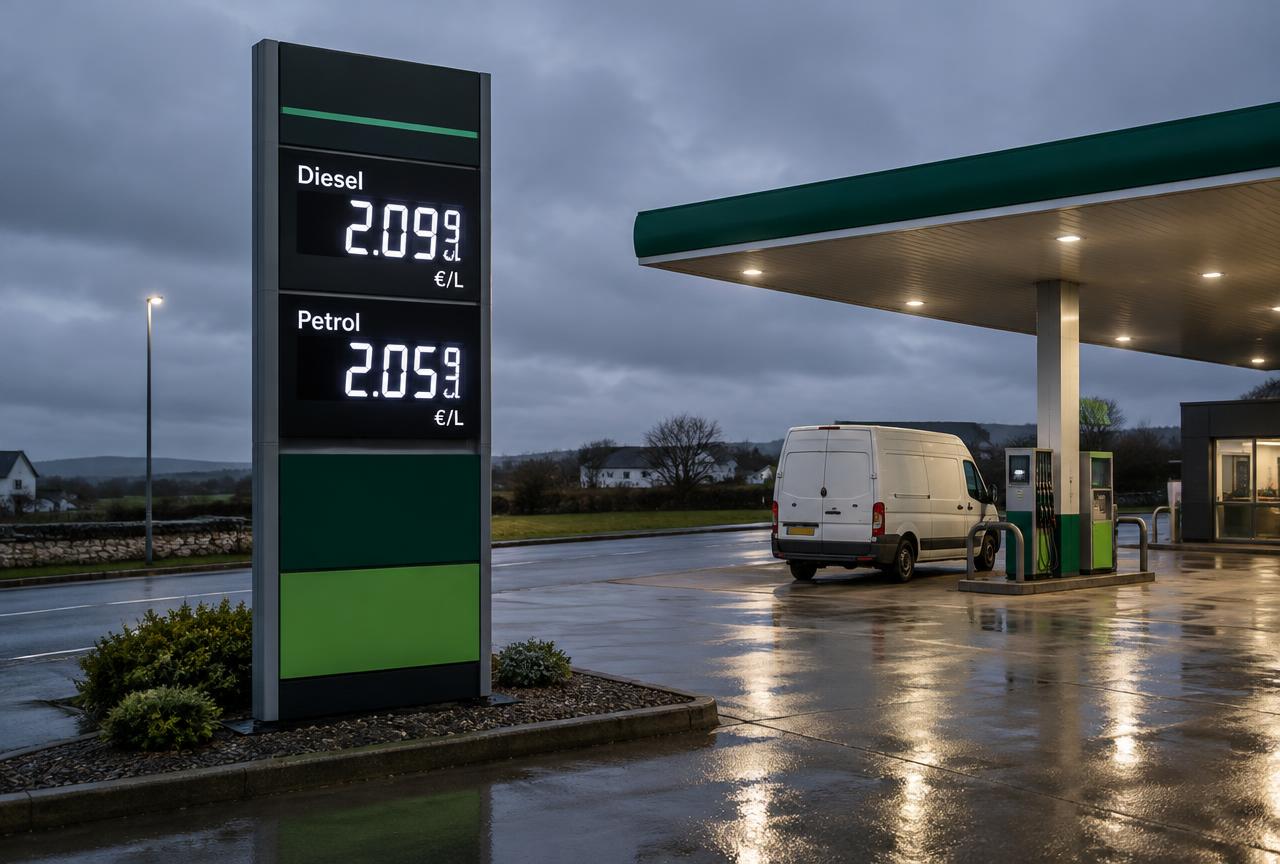
The numbers at the pump don't lie — and for Ireland's business community, what they're saying right now is deeply uncomfortable.
Diesel has topped €2.20 per litre at forecourts across the country. Petrol is nudging €2.00. And for the hundreds of thousands of Irish businesses that depend on fuel to operate — from one-van tradespeople to nationwide hauliers — the cost is no longer a line item. It's an existential threat.
This is not a blip. It's a structural shift that is reshaping how Irish businesses operate, price their services, and plan for the future. The question now is whether government policy can keep pace with the pain on the ground.
How Did We Get Here?
Ireland's fuel price story in 2026 is the result of overlapping pressures, none of which are easily resolved.
Geopolitical tension — particularly instability in oil-producing regions and the aftermath of an Iran crisis earlier this year — pushed global crude prices sharply higher. Before that crisis hit, petrol and diesel averaged around €1.70 per litre at Irish forecourts. Since then, prices have surged by 25 to 30 cent per litre and have not retreated.
On top of global commodity prices, Irish motorists and business operators carry one of the heaviest fuel tax burdens in Europe. More than 50% of the price of diesel at the pump is made up of tax — including excise duty, the carbon levy, a 23% VAT rate, and the NORA levy. For petrol, the tax component is close to 60%. That means even when global oil prices ease slightly, the savings are cushioned by a floor of state charges that don't move.
The Competition and Consumer Protection Commission (CCPC) investigated the recent fuel price surge and found no evidence of price-fixing or anti-competitive behaviour by the industry. Their conclusion: the increases reflect genuine global market conditions. Cold comfort for a business owner filling up a fleet of vans.
The Numbers Hitting Business
For Ireland's transport and logistics sector, the escalation in diesel prices has been brutal.
Fuel accounts for between 30% and 40% of total operating costs for heavy goods vehicles. A single 20 cent per litre increase — which is roughly what the market has delivered this year — can add between €4,000 and €8,000 per vehicle in annual costs. For a haulage firm running 20 trucks, that's potentially €160,000 in additional fuel expenditure every year, with zero offsetting revenue increase unless contracts allow for fuel surcharges — and many don't.
Owner-drivers and small fleet operators are especially exposed. They cannot access the bulk purchasing discounts available to major logistics companies, meaning they pay full pump price with no mitigation. Every journey costs more. Every job quoted weeks ago gets delivered at a loss.
The problem isn't confined to transport. Consider a Dublin cleaning company running 10 vans and employing 30 staff. According to evidence submitted to the Seanad, that operator has seen monthly fuel bills rise by between €1,500 and €2,000 since March — a business whose vans fall below 3.4 tonnes and are therefore ineligible for the Road Transport Support Scheme. The support infrastructure, in other words, is not built for the businesses doing the work on the ground.
Patrick Kirby of Tria Energy, one of Ireland's fuel distributors, put it plainly: “For distributors, normal has become exceptional and the exceptional has become normal. We are managing impacts at the moment that we would never have thought possible.”
Protests, Politics and a €505 Million Response
By April 2026, the pressure had become visible on Irish roads. Protests disrupted supply chains, restricted access to depots and delivery routes, and forced tanker re-routing across the country. Demand spiked as businesses and consumers reacted to uncertainty about supply.
The government moved quickly — announcing a €505 million support package that officials described as part of an ongoing effort on fuel affordability. That announcement came, notably, in the same week as a planned Sinn Féin vote of no confidence, and was widely read through a political lens. Weeks before that, a separate €250 million in measures had been introduced to support fuel-dependent workers.
In August, the government confirmed that planned increases in excise duty on fuel would not go ahead — a significant political concession that acknowledged the pressure households and businesses were under. Extensions of current excise cuts were being discussed into early 2027 at the time of writing.
The cumulative government spend on fuel supports since the crisis began now exceeds €1.4 billion. Budget 2026 also set aside over €640 million in residential and community energy grants. These are large numbers — but for a small business owner watching their margin evaporate at the forecourt, they can feel invisible.
The Ripple Effect Across the Economy
Fuel costs don't stay contained to transport. They move through the entire supply chain.
When a haulier's costs go up, delivery charges go up. When delivery charges rise, production costs rise. When production costs rise, retail prices rise. The CSO's August retail data showed that while overall retail sales volumes grew 0.6% month on month, fuel sales volumes dropped 2.8% — a sign that consumers are actively rationing fuel spending. Annual value of fuel sales was up 5.4% year on year, but volume was down. People are spending more and getting less.
The Central Bank and ESRI are forecasting growth of 2 to 3% this year and next, and unemployment remains steady at 5%. But there are warning signs beneath those headline figures. Deloitte's Kate English noted that “the pace of growth here has slowed over the past year.” The Central Bank forecasts jobs growth of just 1.2% for the year — modest against the backdrop of sustained energy cost inflation.
Sinn Féin Senator Pauline Tully warned in the Seanad that without further supports, businesses could be forced to lay off workers. The heating oil situation adds another layer of household stress: a kerosene tank fill-up now costs up to €1,600 — close to double the previous year — and over 300,000 people are already unable to afford their electricity bills. That is the context in which Irish SMEs are being asked to absorb rising operational costs.
What Businesses Are Doing
Across the country, companies are adapting — but adaptation has limits.
Fleet operators are delaying vehicle replacements and switching to route optimisation software to reduce unnecessary mileage. Some are moving faster toward electric commercial vehicles, though the infrastructure gaps outside Dublin remain a barrier. Larger businesses are negotiating fuel surcharge clauses into contracts. Smaller ones are simply absorbing the cost or passing it on to customers — and watching as competitors who can't absorb it step back from tendering.
Some sectors are considering remote and hybrid working models not for cultural reasons, but for purely financial ones. Sky Business Centres reported a measurable increase in businesses enquiring about virtual office arrangements specifically to reduce commuting and fleet dependency — a commercial decision driven entirely by the fuel price environment.
The Bottom Line
Ireland's fuel crisis is not over. Diesel at €2.05 to €2.30 per litre — against a 2020 baseline of €1.20 — represents a 70 to 90% increase in just six years. For businesses with fuel as a core operating cost, that is not a fluctuation to manage around. It is a fundamental shift in the economics of doing business.
Government supports have been real and substantial, but they have been reactive, politically tinged, and not always targeted at the businesses most exposed. The Road Transport Support Scheme excludes vans under 3.4 tonnes. The excise cuts help everyone at the pump but offer no structural relief to high-mileage commercial operators.
What Irish business needs is a fuel cost framework that doesn't require protests to trigger action — one that builds in automatic protection for SMEs when prices cross defined thresholds, and that accelerates the infrastructure investment that makes commercial electrification a viable alternative rather than an aspiration.
Until then, Irish businesses will keep filling up, keep absorbing, and keep watching the margin shrink one litre at a time.