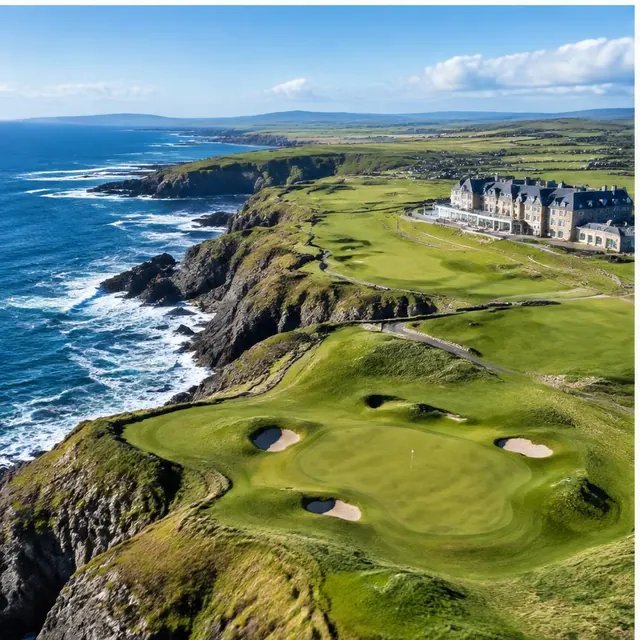
When the Amgen Irish Open tees off at Trump International Golf Links & Hotel in Doonbeg on 10 September, it will mark the first time the tournament has been staged at a Trump-owned venue anywhere in the world, and the second time in eight years the event has come to County Clare. For a resort that was fighting for survival little more than a decade ago, hosting the DP World Tour's flagship Irish event represents the clearest validation yet of the turnaround built since 2014.
A links course a century in the making
The story of Doonbeg predates Trump by well over a hundred years. The site along Doughmore Bay was first identified as a potential golf links in the late 19th century by Scottish Guardsmen stationed in Ireland, who ultimately chose to build at Lahinch instead, leaving the Doonbeg dunes undeveloped. It took until the early 1990s for local community organisers, working through the Doonbeg Community Development Company, to revive the idea. With support from Shannon Development, 377 acres of duneland were assembled from four farming families around Doughmore Bay, and capital from US-based Kiawah Development Partners funded construction.
Two-time Open Champion Greg Norman was brought in to design the course, working under strict environmental restrictions to protect a colony of protected microscopic snails on the site. Norman later called himself "the luckiest designer in the world" for the ground he had to work with. The course, laid out in a single loop of nine holes out and nine back along 1.5 miles of crescent-shaped beach, opened in 2002.
Debt, receivership, and a five-hour deal
Despite the quality of the setting, the resort could not make the numbers work. By 2011 it had reportedly lost $70 million, and by the time its 2012 accounts were filed, the company behind it carried debts of €80 million. It entered court protection in January 2014 and was put up for sale by receivers Luke Charleton and David Hughes of Ernst & Young. For a village of roughly 700 people, where the resort supported around 300 jobs, the threat was existential — residents at the time described the fear as stark, with one local recalling the reaction as "Oh my God, 300 jobs — gone."
Donald Trump was already familiar with the property, having sent architects to assess it years earlier and having previously tried and failed to buy it. When it came back to market through receivership, he moved decisively. "I closed that deal in less than five hours," he later told The Irish Times. "There are not a lot of people who are able to do that." Media reports at the time put the purchase price at around €15 million, though a receivers' report filed in August 2014 showed the actual proceeds from the sale amounted to just over €8.7 million. Willie Hanrahan, then chairman of the Doonbeg Community Development organisation, welcomed the deal at the time, saying it "secures the 200 jobs at the golf course." Trump's ownership began with an immediate outlay of close to €1 million to repair storm damage the course had sustained.
Rebuilding the course itself
Ownership change brought a significant physical transformation as well as a financial one. Trump brought in golf architect Dr Martin Hawtree — the same designer responsible for reshaping nearby Lahinch and for Trump's Aberdeen links in Scotland — to rework Doonbeg over a two-year period at a reported cost of around €5 million. Hawtree re-routed several holes, redesigned all 18 greens, and adjusted bunkering and contouring throughout, while working within the same environmental constraints Norman had faced. The redesigned course reopened in 2016 and has since been rated among the top links courses in Ireland, playing to a par-72 over roughly 7,000 yards, with views of the Atlantic from 16 of its 18 holes.
How the resort has performed financially
The resort required sustained capital investment through much of its first decade under Trump ownership, running at a loss for several years as the redesign and hotel upgrades were completed. That picture has since turned around. The latest filed accounts for TIGL Ireland Enterprises Ltd, the company behind the resort, show revenue rising 7% to €17.3 million in 2024, up from the prior year, with operating profit increasing 8% to €2.2 million and pre-tax profit of €595,000, compared with €489,000 the year before.
The resort's directors noted increased sales across green fees, membership, accommodation and hotel services, alongside continued "significant international recognition." Staffing figures from 2021, the most recent year published in full, show an average of 137 employees and €4.8 million paid in staff remuneration that year — maintained, the accounts note, despite widespread hospitality staffing shortages at the time. Local Fianna Fáil councillor Gillian Murphy has described the resort as "a hugely important employer and a five-star, top-end tourism project" for west Clare, calling it central to the region's farming and tourism-based economy.
What the Irish Open is expected to deliver
Joe Russell, Managing Director of Trump International Hotel and Golf Links, has put the average economic impact of hosting the tournament at €16 million across the two years of preparation and delivery combined. Clare Chamber of Commerce has separately estimated the event could deliver "tens of millions of euro" in visitor spend to the county, while local business leaders cited in recent reporting have put the impact of tournament week alone at over €20 million for the West Clare region specifically. Roughly 75,000 fans are expected to travel to the area over the course of the week, according to reporting citing the Clare Champion. For scale, the Irish Open's last visit to County Clare, hosted at Lahinch in 2019, drew more than 100,000 visitors and left what Clare County Council has described as a lasting infrastructure legacy for that area, with continued investment in local roads and services.
The tournament and the field
The $6 million DP World Tour event runs from 10 to 13 September, preceded by a Pro-Am on 9 September. Rory McIlroy returns to defend the title he won in dramatic fashion last year, while Shane Lowry — who won the Irish Open as an amateur in 2009 — will make his 18th consecutive appearance in the tournament, one of its most consistent home favourites. General admission tickets start at €35 for the Pro-Am, rising to €65 for the final round, with a weekly pass priced at €170; premium Ticket+ packages start at €155, and Green on 18 hospitality is priced from €549 per person.
The Trump visit
President Trump is expected to attend the tournament's final two days, 12 and 13 September, having previously visited the resort in 2019 as part of a state trip to Ireland. His attendance is expected to bring a substantial multinational security presence to the Clare coast, alongside a significant increase in international media attention on the region during tournament week.
Local and political reaction
Clare County Council has welcomed the tournament as an opportunity to showcase the county's coastline, golf facilities and hospitality on an international stage, and says it has already carried out infrastructure and road network investment in the area ahead of the event. Cathaoirleach Cllr Joe Killeen described the Irish Open's return to Clare, alongside the Walker Cup at Lahinch, as "a wonderful opportunity to showcase the county's stunning scenery, world-class golf facilities and renowned hospitality." West Clare Municipal District representatives have specifically pointed to the legacy left after Lahinch hosted the tournament in 2019 — sustained investment in roads and services — as the model they want repeated around Doonbeg this time.
What This Could Mean for Ireland
International golf tourism already generates more than €300 million annually for the Irish economy, according to Golf Ireland data, and events of this scale illustrate the multiplier effect a single week of elite sport can have on a small rural region. Beyond the tournament's direct spend, the exposure of Doonbeg's Atlantic coastline to a global broadcast audience adds long-term visibility for hotels, restaurants and tour operators across Doonbeg, Kilkee and the wider West of Ireland — value that extends well beyond the week itself.
The Bottom Line
A resort that stood on the edge of collapse in 2014 has grown into a five-star, revenue-generating employer for west Clare and is now hosting one of the biggest weeks in Irish sporting tourism this year, with independently estimated economic impact running into the tens of millions of euro and a full field of the sport's leading Irish and international names competing on its Atlantic coastline.