There is a moment in the story of Combilift that tells you everything you need to know about how Martin McVicar thinks.
It is 1998. He and co-founder Robert Moffett have just built their first three multidirectional forklifts. The company is 13 people working out of Monaghan. They have no established export infrastructure, no global dealer network, no track record in international markets. And 17 of the first 18 Combilifts they produce go straight overseas.
Not because they fell into exporting. Because they decided from day one that the home market would never be enough — and that if you design something genuinely new, the world will buy it.
That instinct, repeated and refined across 28 years of continuous growth, has produced one of the most quietly extraordinary manufacturing businesses in Ireland. Industry coverage puts Combilift's annual turnover above €500 million, and the company employs around 1,000 people, about 850 of them at its Monaghan home. It distributes through a global dealer network reaching customers in more than 85 countries, and operates from a 46,500 square metre global headquarters in Monaghan.
And it has won Irish Exporter of the Year three times — in 2008, 2015, and 2024 — becoming the first Irish company ever to do so.
McVicar's response to that third win was characteristic: he compared it to an Olympic gold medal. Not because of the trophy. Because of what it represents — recognition from independent judges that Combilift competes at the highest level of global manufacturing and wins on merit.
The Product Is the Strategy
McVicar's philosophy on business is inseparable from his philosophy on product. In an era when Irish business conversation often gravitates toward software, platforms, and services, Combilift is a reminder that you can build a globally dominant company by making physical things better than anyone else — and by solving problems that competitors have not noticed, or have decided are too niche to bother with.
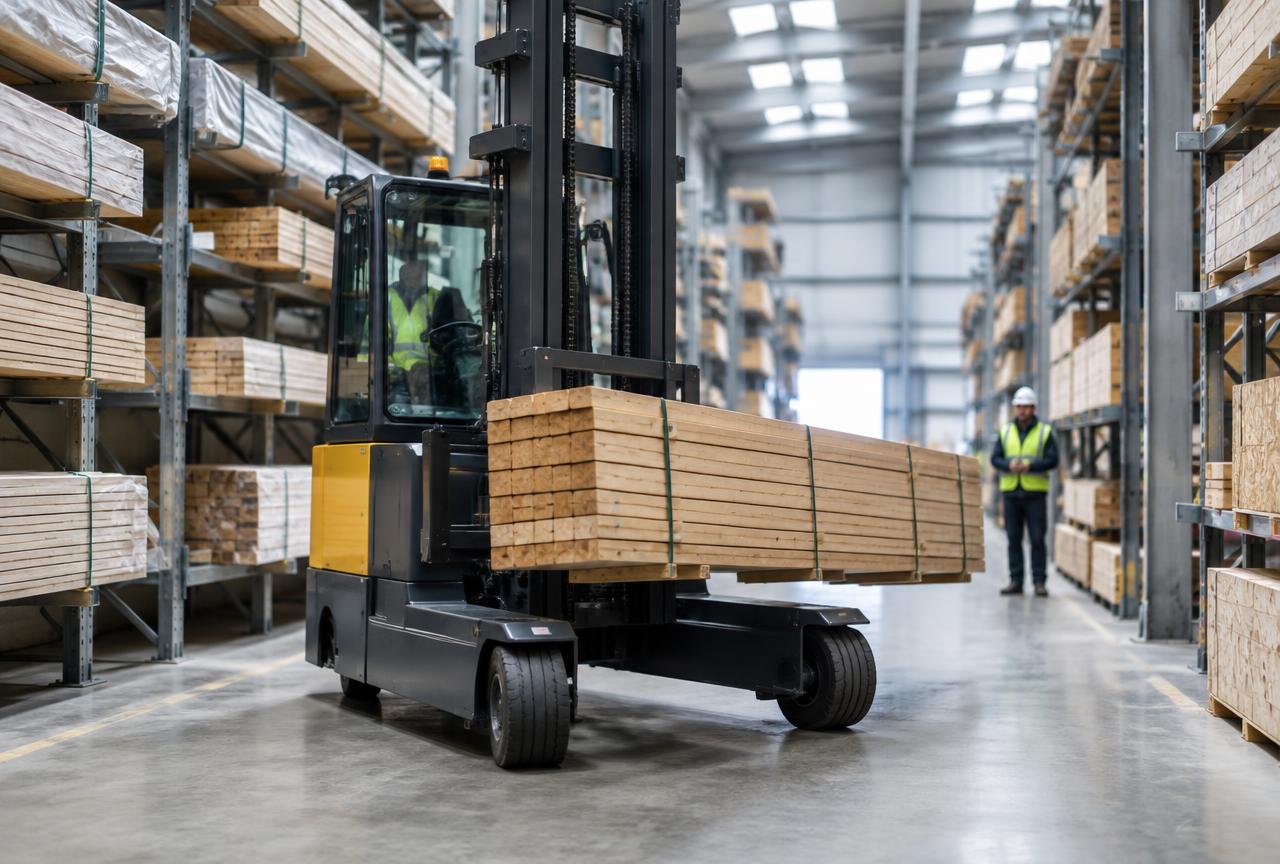
The original Combilift was born from exactly that instinct. Conventional forklifts move forward and backward. They need wide aisles to manoeuvre, which means warehouses are built around the forklift's limitations rather than the customer's needs. The Combilift C-Series could travel sideways — multidirectional — making it possible to handle long loads in narrow aisles without the vast space requirements of conventional equipment.
It sounds obvious in retrospect. It was not obvious at the time. The original four-tonne C-Series, introduced in 1998 as the C4000, remains in production today — you only make a product that durable when you have genuinely understood a problem rather than approximated a solution.
"We don't make regular products, we design them from the ground up in order to solve a problem for a customer," McVicar has said.
That is a competitive strategy, not a marketing line. Every Combilift is built to order, with customers specifying features and configurations. The planning team maps out warehouse storage improvements free of charge before a sale is made — demonstrating value before asking for a commitment. Its core innovations are patented internationally, and in 28 years the company has never rebadged a product it bought from someone else.
The Export Model: Built In, Not Bolted On
For many Irish manufacturers, exporting happens after the home market is established. For Combilift, export was the founding condition.
McVicar attributes part of this to practical reality: the Irish market for specialist material handling equipment was never large enough for Combilift's ambitions. But something more fundamental is at work. By designing products that solve universal problems — narrow aisle handling, long load management, maximising warehouse storage — it created something any industrial business anywhere might need. The product was global before the company was.
The logistics model reinforced this. Compact multidirectional trucks fit into standard shipping containers, keeping freight costs low enough for global distribution to work. Larger equipment — straddle carriers reaching 14 metres high — is engineered to be disassembled and shipped the same way. "So far, we've never had a vehicle we couldn't ship," McVicar has said.
When your product can reach any market at reasonable cost, your addressable market is every warehouse and industrial facility on earth. Combilift has spent 28 years working through it.
Debt-Free, Private, and Growing
One of the most distinctive facts about Combilift is one that rarely gets the attention it deserves: it is privately owned and, by the company's own account, has never carried debt. McVicar says revenue has grown in every year of its existence apart from one — the 2008/09 financial crisis, when it contracted alongside global industrial output before resuming its upward trajectory.
In a landscape where growth is often financed by leverage and private equity has become the default route to scale, Combilift has taken a different path: reinvesting its own earnings, keeping ownership and control, and building at a pace its own cash generation can sustain.
The result is a business that does not need to satisfy external capital on a quarterly basis. It can invest in long-term product development, workforce training and infrastructure — a 46,500 square metre global headquarters — without the pressure of short-term returns.
McVicar's background informs this approach. He grew up on a farm — an environment where hard work, self-reliance and the long-term care of assets are practical necessities rather than aspirational values. The parallels with how Combilift has been built are not incidental.
The People Model: Training From the Ground Up
Combilift's approach to workforce development is as deliberate as its approach to product. In the Cavan-Monaghan border area, not typically associated with high-technology manufacturing, it has built one of the most sophisticated engineering workforces in Ireland.
It did not do this by waiting for the education system to produce the talent it needed. It built the pipeline itself.
More than a decade ago, in partnership with Cavan and Monaghan Education and Training Board, Combilift developed a QQI Level 5 Mechatronics traineeship — the first industry-led traineeship of its kind in Ireland, on McVicar's account. It takes 16 to 18 students per year, runs from September to May, and is designed around the specific skills Combilift and its peer companies in the regional engineering sector need. A QQI Level 6 original equipment manufacturing apprenticeship, developed with other companies through Enterprise Ireland's Mid Tier Engineering group, followed in January 2019.
McVicar is direct about why: "I'm convinced there is always going to be jobs for apprentices." Where manufacturing employment is often framed around automation and displacement, his view is that skilled hands-on engineering will remain essential — and that companies investing in that skill will hold a durable advantage.
It also runs school tours, primary school STEM projects and teacher development programmes — cultivating interest in engineering in the region it is rooted in rather than waiting for it to appear.
What Irish Business Should Learn
The Combilift story carries lessons that extend well beyond the materials handling sector.
First: niche is not a limitation. Combilift found a specific, underserved problem in the global industrial market and solved it better than anyone else. Being the world's best at something specific beats being reasonably good at something general.
Second: export from day one. Establishing the home market first is understandable, but it often means arriving abroad as a mature, risk-averse company rather than a hungry one. Combilift's founding global orientation is part of what made its network possible.
Third: own your product. In a world of platforms, partnerships and white-labelling, a moat belongs to companies that design, build and own their intellectual property. Combilift's patents, custom engineering and refusal to rebadge are the foundation of its pricing power and resilience.
Fourth: build without debt if you can. It is not always possible. But the freedom it creates — to invest long-term, to weather downturns without restructuring, to decide without external pressure — is a competitive advantage across every part of the business.
McVicar built Combilift from a field in Monaghan into a €500 million global business without venture capital, a stock market listing, or a single year of debt. He did it by solving a real problem, designing it properly, and selling it everywhere.
That is a blueprint worth studying.
The Bottom Line
Martin McVicar and Combilift are the clearest possible demonstration of what Irish indigenous manufacturing can achieve when it combines genuine innovation with relentless global ambition. Three Irish Exporter of the Year titles. Turnover above €500 million. Around 1,000 employees. More than 85 countries. No debt. One lesson: build something the world actually needs, make it better than anyone else, and then sell it everywhere. Monaghan to the world — and still growing.