An Idea That Started With a Millennium
The story of American college football in Ireland begins not with a sports promoter or a television network but with a civic celebration. In 1988, Dublin was marking the 1,000th anniversary of its founding, and Aidan J. Prendergast — a former president of the Irish American Football Association — had been pitching a bold idea on both sides of the Atlantic for several years: bring a major NCAA-sanctioned college football game to Ireland, tap into the enormous Irish-American diaspora in the United States, and give Dublin a sporting event unlike anything it had hosted before. On 19 November 1988, Lansdowne Road hosted Boston College and Army in what was called the Emerald Isle Classic, and 42,524 fans filled the stadium to watch Boston College defeat the heavily favoured Army Black Knights 38-24. It was the first major NCAA-sanctioned college football game ever played in Europe.
That single game planted a seed that took nearly four decades to fully flower. What began as a one-off millennium celebration has grown, through a series of revivals, gaps and reformulations, into a permanent annual fixture on the Irish sporting and economic calendar — one that now generates over €130 million per edition for the Irish economy and attracts tens of thousands of American visitors who stay an average of seven nights and spread their spending far beyond Dublin.
The Full History: Every Game, Every Venue
The Emerald Isle Classic returned in 1989 when Pitt defeated Rutgers 46-29 at Lansdowne Road, this time in front of a more modest crowd of 19,800. Without the novelty factor and the millennium backdrop, the event struggled to sustain the same momentum, and the series went on an extended hiatus. A Division I-AA game between Holy Cross and Fordham was played at the Gaelic Grounds in Limerick in 1990, drawing around 12,000 spectators. A 1993 game at Fitzgerald Stadium in Killarney was scheduled but cancelled.
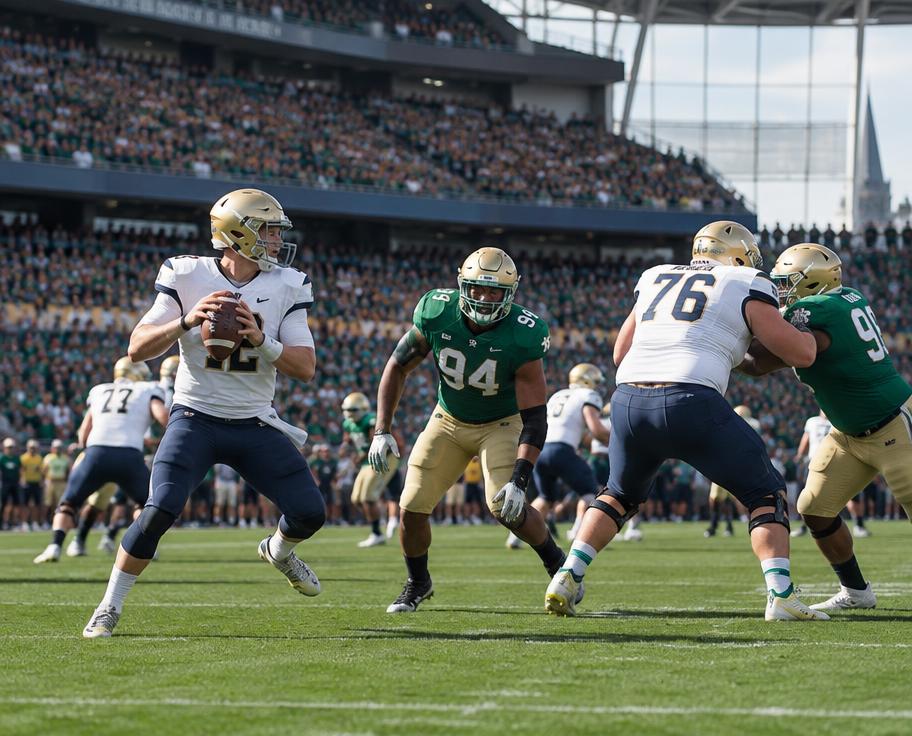
The next significant chapter opened in 1996, when Notre Dame and the United States Naval Academy played at Croke Park under the name the Shamrock Classic, drawing over 38,000 fans. Notre Dame won 50-24. The two programmes remained the central draw for the event's Irish editions — there was something about the Notre Dame-Navy rivalry and Notre Dame's deep Irish-American cultural identity that resonated particularly strongly with Irish audiences and with the diaspora. They returned to Dublin in 2012 at the newly rebuilt Aviva Stadium, this time as part of Ireland's "The Gathering" tourism initiative, which was specifically designed to encourage Irish-Americans to return to their heritage. The 2012 game became the Aviva's first advance sellout: 15,000 tickets sold in less than two hours, approximately 35,000 Americans travelled to Dublin, and Notre Dame won 50-10. The economic impact of the 2012 game was estimated at €100 million for the Irish economy. It was, in the words of those who organised it, the proof of concept that changed everything.
The 2014 game at Croke Park — now called the Croke Park Classic — between Penn State and UCF set an Irish college football attendance record of 53,304 fans. Penn State won 26-24 in a game that went to the final moments. In 2016, Georgia Tech defeated Boston College 17-14 at Aviva Stadium in what was now formally branded the Aer Lingus College Football Classic, with Aer Lingus coming on board as the title sponsor in a partnership that has defined the event's identity since.
A planned 2020 edition — which would have been the third Notre Dame-Navy meeting on Irish soil — was cancelled due to the COVID-19 pandemic, with the game moved to Annapolis, Maryland. The event returned in 2022, when Northwestern defeated Nebraska 31-28 at Aviva Stadium in the first Dublin college football game in six years. Notre Dame and Navy completed their long-delayed Irish trilogy in 2023, with Notre Dame winning 42-3 in front of 49,000 fans — the largest attendance at Aviva Stadium for the event and the highest since 2014. The game also saw ESPN's College GameDay broadcast live from Dublin for the first time, marking the first time the show had gone outside the United States.
The Economic Engine: Four Consecutive Sell-Outs, €514 Million and Counting
Since the event became an annual fixture from 2022, the economic data has been consistent and significant. Grant Thornton's post-game economic impact reports — commissioned by the event's organisers, Irish American Events Ltd, a joint venture between Corporate.ie and On Location — have provided the most detailed picture available of what the Classic delivers for Ireland.
The 2024 edition, in which Georgia Tech defeated No. 10 Florida State 24-21 at Aviva Stadium, was the fourth consecutive sell-out. The 2025 edition — Iowa State defeating Kansas State 24-21 before 47,226 fans, with 22,910 US visitors in attendance — generated a verified €132 million economic boost for the Irish economy, according to Grant Thornton's Post-Game Economic Impact Report published in February 2026. American visitors to the 2025 game stayed in Ireland for an average of 7.1 nights, visiting an average of three destinations across the island, a pattern that spreads tourism spending well beyond Dublin and into regional hospitality and accommodation businesses. The game was broadcast live on ESPN in the United States, attracting a peak audience of 4.7 million viewers and an average of 4 million — the second most-watched sports telecast of that weekend in the US behind the Tour Championship golf final on NBC.
The combined economic impact of the four annual games from 2022 through 2025, as confirmed by Grant Thornton's reports, totalled €382 million. Adding the €132 million from 2025 to the pre-event projections for the 2026 edition — TCU Horned Frogs versus North Carolina Tar Heels on 29 August 2026 — brings the projected cumulative total across the first five annual editions to over €514 million. Fáilte Ireland CEO Caroline Bocquel, commenting on the 2025 figures, described the event as showing "how significant that impact can be" and noted it "continues to deliver exceptional value for Ireland, attracting tens of thousands of international visitors and generating major national and regional economic benefits."
The Much More Than A Game Programme
One dimension of the Aer Lingus College Football Classic that distinguishes it from a straightforward sporting fixture is the ecosystem of events that has grown around it under the "Much More Than A Game" initiative. Since the annual series began, each game week has generated more than 40 business, academic, political, community, social and sporting events alongside the game itself. The 2025 edition saw Enterprise Ireland and UCD host the first One Health x AgTech summit, at which a Memorandum of Understanding was signed — an example of the Classic being used as a platform for substantive bilateral economic and academic engagement between Ireland and the United States, not merely a backdrop for tourism. Minister for Enterprise, Tourism and Employment Peter Burke described the event's success as showing "how important the event is in the annual tourism calendar for visitors and locals alike."
The event is promoted by Irish American Events Ltd and co-founded by Padraic O'Kane, who described the 2025 edition's atmosphere as showcasing "the essence of sport through two sets of clashing fans delivering a once in a lifetime atmosphere inside The Aviva Stadium." Aer Lingus CEO Lynne Embleton described the game as bringing "an exceptional boost" to the Irish economy, adding that the airline is "looking forward to another successful game" as the 2026 edition approaches.
What Comes Next
The 2026 edition — TCU versus North Carolina on 29 August — carries an additional dimension that is generating particular attention in the US college football community: UNC is coached by Bill Belichick, the eight-time Super Bowl champion making his college head coaching debut. Belichick's presence in Dublin is expected to drive significant additional American media interest. Future scheduled games include Pitt versus Wisconsin on 28 August 2027 — a return to Dublin for Pitt, which played in the very first Emerald Isle Classic back in 1989 — while organiser Padraic O'Kane has confirmed strong interest from several top-tier college football programmes keen to play in Dublin in the years ahead. Competition from other European locations is also growing: Frankfurt is scheduled to host Michigan in 2026, and organisers have acknowledged "they're all looking at what's going on in Dublin and saying they want in on some of that."
The Bottom Line
College football's presence in Ireland has travelled a remarkable distance from a single promotional game in 1988 to a permanent annual fixture generating over €130 million per edition and building toward a verified cumulative economic impact of more than €514 million across five years of annual play. Four consecutive sell-outs at Aviva Stadium, tens of thousands of American visitors staying an average of seven nights, and a television audience of millions in the United States have established Dublin as the European home of college football in a way that is now attracting competition from the rest of the continent. The numbers make the case plainly: this is one of the most commercially successful recurring sporting events in modern Irish history.