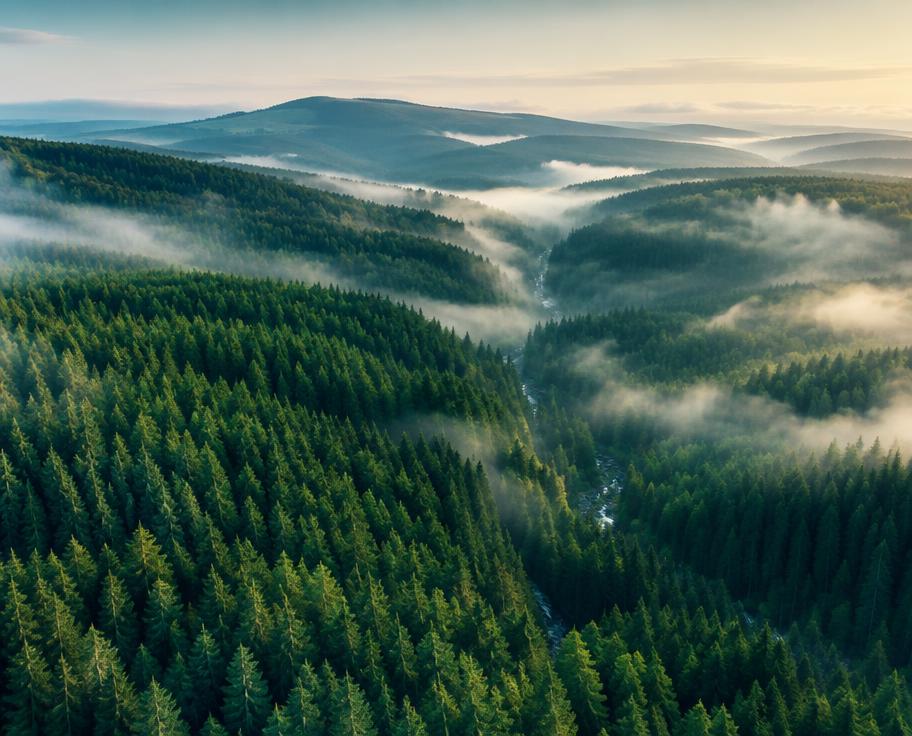
There is a type of climate action that happens without headlines, without press releases and without quarterly reports. It happens in the slow growth of a spruce tree in Wicklow, the rewilding of a clearfelled hillside in Clare, the silent work of a forest floor absorbing carbon from the atmosphere over decades.
Coillte manages 440,000 hectares of primarily forested land across Ireland — approximately 7 per cent of the country's total land mass and 47 per cent of its forests. It is Ireland's largest forester, its largest provider of outdoor recreation and a significant supplier of sustainable timber to the construction industry. It is also, quietly, one of Ireland's most important climate assets.
The Carbon Numbers
Coillte's forests play a direct role in Ireland's national carbon accounting. The company's New Forestry Model — its strategic framework for managing the estate — is projected to deliver an emission reduction saving of approximately 19 million tonnes of CO2 over the period 2021 to 2100, compared to a business-as-usual scenario.
In the near term, the model targets a reduction of approximately 863,000 tonnes of CO2 for the period 2026 to 2030, contributing to Ireland's EU burden-sharing obligations under the Land Use, Land Use Change and Forestry framework.
At the operational level, Coillte has set a target of a 51 per cent reduction in its own Scope 1 and Scope 2 emissions by 2030 compared to 2018 levels, with a long-term goal of net zero across all scopes by 2050. In 2024, total operational Scope 1 and Scope 2 emissions were approximately 58,135 tonnes of CO2 equivalent — a slight decrease on 2023 — reflecting ongoing progress against that target.
Nature as Strategy
Coillte manages approximately 90,000 hectares — around 20 per cent of its estate — primarily for nature and biodiversity. Its strategic vision sets a target of increasing this to 30 per cent, an additional 44,000 hectares dedicated to ecological management rather than commercial timber production.
The long-term ambition is more significant still: targeting that 50 per cent of the total estate is managed primarily for nature over time. That represents a fundamental rebalancing of how Ireland's largest forester thinks about its land.
The Build with Wood Conference, held at Beyond the Trees Avondale in October 2025 and attended by over 200 national and international experts, highlighted a complementary dimension of Coillte's climate contribution: sustainable timber from Irish forests as a low-carbon alternative to concrete and steel in construction. Timber-framed homes store carbon rather than releasing it. As Ireland targets 300,000 new homes by 2030, the role of Irish-grown sustainable timber in that programme is commercially and environmentally significant.
Coillte produces approximately 3 million cubic metres of sustainable certified wood annually. Both its forest estate and its timber products carry Forest Stewardship Council and Programme for the Endorsement of Forest Certification accreditation — the internationally recognised standards for responsible forest management.
The Skills Pipeline
Coillte CEO Imelda Hurley has been direct about one of the less visible constraints on delivering Ireland's forestry ambitions: people.
"The forestry sector is recognised as a key driver of Ireland's climate action and housing targets," Hurley said at the launch of the 2026 Forestry Scholarship Programme in December 2025, "and will require more skilled professionals by 2030 to meet the ambitions of Ireland's Forest Strategy."
The scholarship programme — now in its third year — offers recipients up to €20,000 across a forestry degree at South East Technological University or University College Dublin, with paid summer placements and a pathway to employment at Coillte. Applications for 2026 closed in May. The programme attracted a 25 per cent uplift in applications year on year in 2025, and four of the six current scholars are women — reflecting the changing face of a sector that was historically male-dominated.
The 12 forest parks, 260 recreational areas and 3,000 kilometres of waymarked walking trails that Coillte maintains across Ireland attract millions of visitors annually and underpin a significant portion of Ireland's rural tourism economy.
The Ambition Ahead
Coillte's 2022 strategic vision set a target of enabling the creation of 100,000 hectares of new forests by 2050 — supporting the delivery of one third of Ireland's national afforestation target and creating a carbon sink removing 28 million tonnes of CO2 from the atmosphere by 2050. The vision also targets 1,200 new direct and indirect jobs in rural communities and €100 million in investment in world-class visitor destinations by 2030.
Delivering those targets requires faster planning approvals, a reliable pipeline of suitable land and the skilled workforce that the scholarship programme is beginning to build.
The Bottom Line
Coillte's contribution to Ireland's climate future is not measured in press releases — it is measured in hectares restored, tonnes of carbon sequestered and cubic metres of sustainable timber supplied. Managing 7 per cent of Ireland's land well is climate action at genuine national scale. The question is not whether the asset matters — it clearly does — but whether Ireland is investing in the people, planning and policy infrastructure needed to realise its full potential.