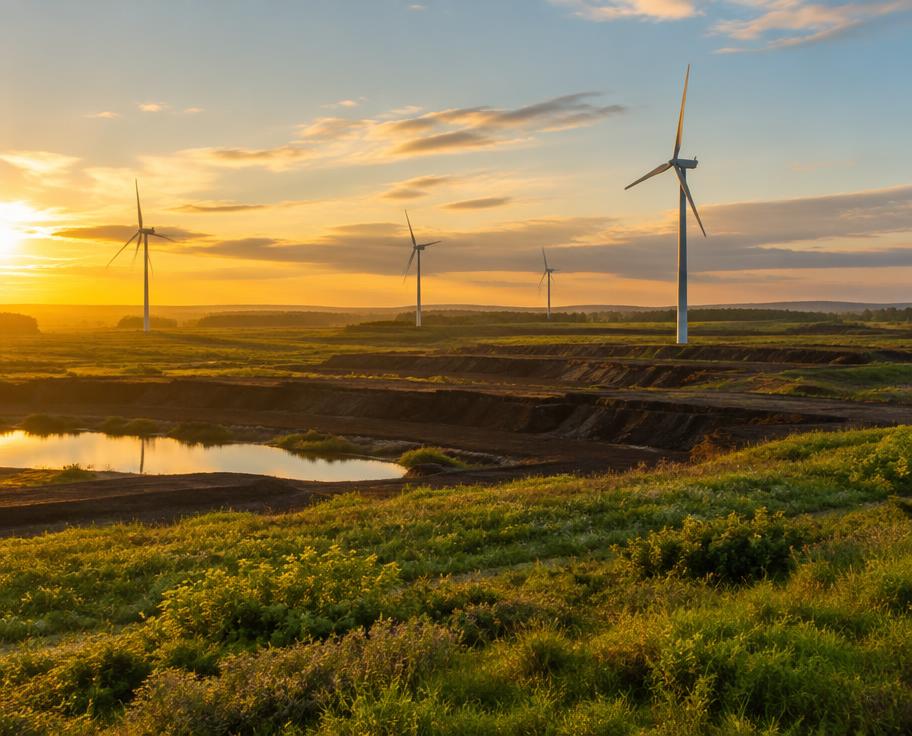
The last peat briquette rolled off the production line. The last delivery of peat was made to Edenderry Power Station. And with those two unremarkable moments, a chapter of Irish industrial history — and a significant source of national carbon emissions — closed for good.
Bord na Móna, the semi-state company that spent the better part of a century extracting and burning peat from the Irish midlands, is now a renewable energy business. It is not a partial transformation or a repositioning exercise. It is a complete change of identity, purpose and impact — and the financial results confirm it is working.
The Scale of What Changed
At its peak, Bord na Móna was emitting approximately 10 million tonnes of CO2 per year through its peat operations. That single figure — 10 million tonnes annually — captures what the Brown to Green transformation actually means in climate terms.
The company concluded all former peat operations and all use of peat as an energy source. It transitioned its workforce from peatland operatives to skilled professionals in renewable energy, peatlands rehabilitation and biodiversity management. Employees who spent their careers on the bog now work as community liaison representatives on wind and solar projects.
In Financial Year 2025 — the first complete year operating as a fully transformed renewable energy business — Bord na Móna reported an operating profit of €31.9 million. It delivered 260 megawatts of new generation capacity to the national grid through the Derrinlough Wind Farm, the Cloncreen Battery Energy Storage System and the Timahoe North Solar Farm, developed in partnership with ESB. It invested €111 million in renewable infrastructure over the year. And it achieved a 38 per cent reduction in its greenhouse gas emissions year on year.
The 5GW Pipeline
Bord na Móna has built a renewable energy pipeline targeting 5 gigawatts of installed capacity — delivered through a combination of wholly owned projects and joint ventures with ESB, SSE Renewables and Ocean Winds.
The €1 billion joint venture with SSE Renewables targets up to 800 megawatts of new onshore wind capacity alone. The company's eco-energy park — its first — has launched with anchor tenant Amazon Web Services, signalling the commercial appetite for the kind of large-scale, grid-connected renewable energy infrastructure that only companies with Bord na Móna's land bank and grid relationships can provide.
The overall target is to deliver 3.5 terawatt hours of renewable energy by 2030 — enough to supply approximately one-third of all Irish homes.
Peatlands Restoration: 20,000 Hectares and Counting
The renewable energy story is the one that gets the headlines. But the peatlands restoration programme is arguably the more remarkable achievement.
Since the Peatlands Climate Action Scheme commenced, Bord na Móna has rehabilitated 20,000 hectares of former peat extraction land. In Financial Year 2025 alone, 2,778 hectares were restored. These are not passive interventions — restored peatlands actively sequester carbon, restore biodiversity and provide recreational spaces for communities across the midlands.
The scheme represents a direct conversion of the land that was the source of Ireland's largest legacy emissions into an active carbon sink. The scale and pace of that conversion — achieved while simultaneously building a new commercial energy business — is without precedent in Irish environmental history.
Community and Commercial Together
Bord na Móna distributed €1.4 million through renewable energy community benefit funds in FY25, supporting education, local business and community schemes in the areas adjacent to its wind and solar projects. Scholarship programmes at Cloncreen and Oweninny wind farms supported 22 students with €165,000 committed to STEM and sustainability studies. The Accelerate Green business accelerator programme has supported 60 companies since its launch.
Chief Executive Tom Donnellan has framed the transformation consistently: putting sustainability and innovation at the heart of the business strategy has enabled the company to evolve — and to do so commercially as well as environmentally.
The Bottom Line
Ten million tonnes of CO2 per year to zero peat operations. A 5GW renewable pipeline. Twenty thousand hectares of restored bog. The highest operating profit in the company's history. Bord na Móna's Brown to Green transformation is not a future ambition — it is a documented, verified, commercially successful reality. For any organisation contemplating what genuine structural transformation looks like, it is one of the clearest examples Ireland has produced.